Treasury and the IRS in December sought to enable customers with a new listing of cars that may be suitable as of Jan. 1 or later. On the other hand, the listing had elevated issues around how the cars are staying categorised.
Treasury did not classify the Cadillac Lyriq as an SUV, for example, meaning its retail value could not exceed $55,000. The Lyriq, which Automotive News classifies as a midsize crossover, starts at $62,990. Under the new car classification expectations announced Friday by Treasury, the Lyriq would be regarded as a tiny SUV.
Standard Motors explained final thirty day period it was addressing the fears with Treasury and the office “should really leverage present U.S. government definitions and methods, utilizing standards and procedures comparable to that applied by” the EPA and the Electricity Division.
In a assertion Friday, GM mentioned it appreciated Treasury’s alignment with the auto classifications on FuelEconomy.gov, noting that qualifying clients now will be ready to obtain the $7,500 tax credit for the Lyriq.
“The alignment on classification will offer the essential clarity to people and sellers, as very well as regulators and manufacturers,” GM said.
A further illustration was Tesla’s foundation Design Y in the U.S. The Model Y’s two-row version skilled as a sedan, but the significantly less popular a few-row edition capable as an SUV, according to how Treasury was previously classifying autos.
Just before producing substantial value cuts to the Product Y, Tesla CEO Elon Musk complained on Twitter about the classification of the two-row Product Y as a auto and urged Tesla admirers to complain directly to the IRS.
The Alliance for Automotive Innovation, which signifies GM and other major car companies, mentioned automakers need to self-certify to Treasury what classification a motor vehicle is promoted as, according to remarks submitted to the division in November.
“A quite superior decision that clears up some EV tax credit confusion and quickly aids shoppers searching right now (and tomorrow) for an electric powered crossover or SUV,” John Bozzella, CEO of the alliance, reported Friday in reaction to Treasury’s announcement.
Treasury on Friday also said it is nonetheless preparing to problem proposed direction on the shopper tax credit’s significant mineral and battery element needs in March following missing its calendar year-finish deadline in 2022. Those people requirements do not get influence right up until immediately after the assistance is issued.
The hold off and adjustments to automobile classifications have potentially skilled a lot more vehicles for the whole credit in the interim.
On the other hand, U.S. Sen. Joe Manchin, D-W.Va., who helped craft the Inflation Reduction Act and EV tax credits, reported making it possible for motor vehicles to get the credit history without the need of meeting the sourcing regulations goes from the law’s congressional intent.
Manchin released legislation past thirty day period that would direct Treasury to straight away prevent issuing $7,500 client tax credits for EVs that do not meet the demanding significant mineral and battery ingredient requirements.
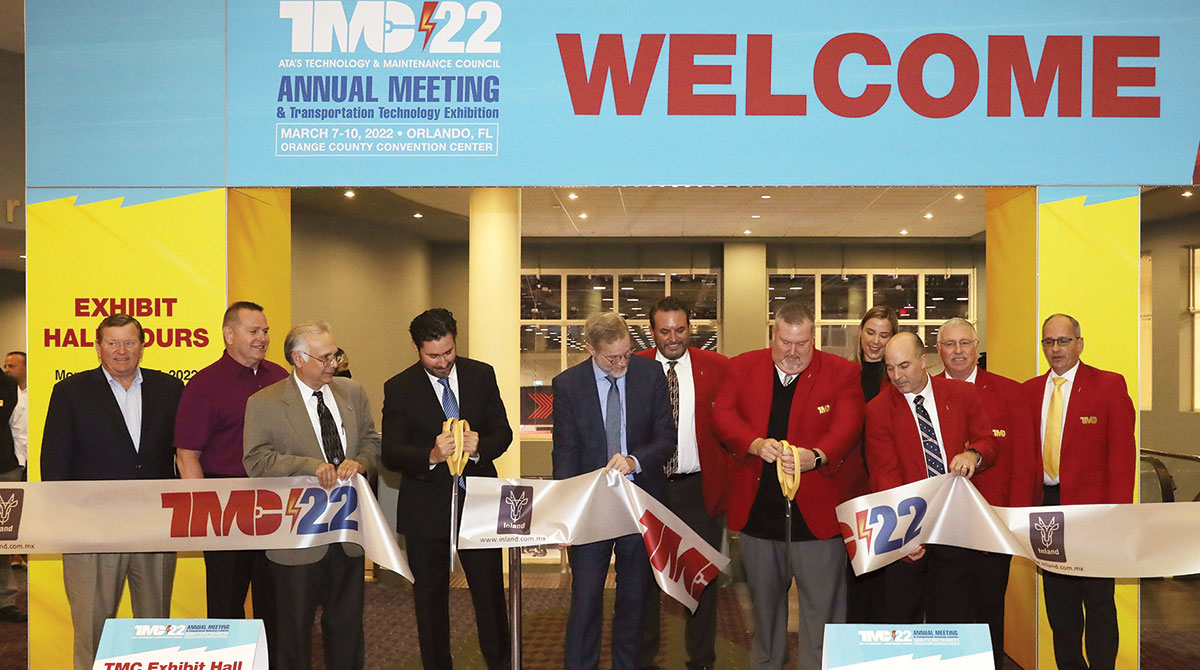
The opening of the exhibit ground at the Engineering & Routine maintenance Council’s 2022 Once-a-year Conference in Orlanda, Fla. (John Sommers II for Transport Topics)
Brakes and telematics will take heart stage at two significant complex classes in the course of TMC’s 2023 Yearly Conference & Technological innovation Exhibition at the Orange County Convention Centre in Orlando, Fla., Feb. 27-March 2.
Equally sessions — titled “Does the Industry Require an Open Telematics API?” and “A Fresh Look at Aftermarket Brake Lining Classification” — are designed to support educate fleet staff on important developments in the areas of brake lining classification and the will need for a open up regular for telematics application programming interface. Based on fleet members’ consider on these two issues, TMC’s connected task forces will commence crafting new or updated encouraged tactics to clear up the technological challenges linked with every single.
Guaranteeing Compatibility When Picking out Aftermarket Brake Linings Remains Difficult
Changing brake linings can be tricky organization for fleet administrators. There are a good deal of options available when it will come to specifying the lining material for a vehicle’s initial reline, all that includes various effectiveness and value criteria.
Keeping with initial tools maker (OEM) sections is a single way to make sure shut compatibility with the initial lining specification, but it can be a additional costly proposition. Aftermarket linings can be much less pricey, and just as capable as OEM offerings, but how does a fleet supervisor know, because aftermarket friction overall performance is fully unregulated in North The united states?
Harmless operation of a major-duty air-braked motor vehicle rides on the driver’s comprehending of the properties and response of the automobile in all conditions. Even with a whole suite of latest advanced driver guidance process (ADAS) systems on board, a driver must be self-confident that the automobile to which they are assigned will answer flawlessly and consistently to push inputs. The most critical factor of all car or truck safety is the braking technique, which have to make the friction vital to dissipate the kinetic electricity of a completely loaded blend vehicle and provide it to a end as it was designed to do by the OEM, repeatedly and consistently across the environmental disorders that a driver will deal with during each individual trip.
As automobiles accumulate time and miles in assistance, brake linings will have to have plan substitution. Even so, specifying aftermarket brake parts that will realize comparable-to-first efficiency can be difficult. Spec’ing aftermarket brake linings can be a charge-efficient and secure option, but it requires being familiar with the balancing act involving cost efficiency and efficiency in an basically unregulated aftermarket.
TMC’s S.6 Chassis & Brake Methods analyze team has reactivated a prolonged-standing undertaking drive to evaluate TMC RP 628C, Aftermarket Brake Lining Classification, which was very first made much more than 20 several years in the past to support fleets in this routine maintenance obstacle by supplying a brake classification listing of aftermarket goods in cooperation with the SAE Worldwide affiliated General performance Review Institute (PRI). Chaired by Ron Moody of Haldex Brake Merchandise, the job pressure will handle technological variables that have arisen because the last revision.
Leaders in the TMC endeavor force will carry out what probably will be extreme conversations around the PRI listing and how it may will need to be up to date to keep it applicable and effective. As additional production of aftermarket merchandise has moved offshore in excess of the a long time, participation in the listing has become extra sporadic, and inquiries from fleets into the listing have decreased. RP 628C is properly the only this kind of useful resource offered to the market, and the recent revision method is noticed as pivotal to fleets, in particular lesser organizations and independent operators in currently being equipped to assess general performance from OEM certification to the Federal Motor Car Security Regular (FMVSS) No. 121, Air Brake Methods.
An additional aspect is the affect of regenerative braking on the conditioning of the frictional substance thanks to the loading distribution variances of electrical automobiles when compared to internal combustion motor-driven motor vehicles. Brakes for electric powered autos may changeover to more compact brakes with additional aggressive brake materials. This change in running parameters has brake suppliers watching initially failure modes incredibly carefully, therefore aftermarket friction makers will also have to have to find out these essential classes to developing a prosperous friction substance for these programs. Likewise, the emergence of automatic driving techniques (Ads) will need that initial equipment and aftermarket suppliers alike evaluate servicing implications and functions info, and knowledge grows.
During TMC’s approaching annual conference, the S.6 examine group will present its findings on the matter through its mini-technical session scheduled for Feb. 28. This session will not only overview the a variety of technological factors of the present market, but will also find fleet perspectives on RP 628C’s relevance and worth to take into account all through the present revision debates. Fleet attendance and participation in the session as very well as the process force’s doing the job assembly on the issue scheduled for Feb. 27 are considered very important.
Enabling Synthetic Intelligence-Pushed Upkeep
Telematics is certainly revolutionizing motor vehicle maintenance. The volume of data that is now obtainable to fleet professionals is astounding in comparison to just a few small several years in the past. Even so, the availability of this facts and the engineering that is earning it probable is providing new worries to fleets, suppliers, upkeep vendors and makers alike.
These concerns will be regarded below the auspices of TMC’s S.12 Onboard Automobile Electronics research team, examining the repercussions and probable value of TMC recommending an open telematics programs programming interface (OTAPI) protocol as an industry apply. An S.12 undertaking power has been analyzing this kind of a protocol for the last yr with the Nationwide Motor Freight Transportation Association (NMFTA) in which fleets could specify to the telematics assistance vendors (TSPs) that a prevalent API be utilised in lieu of proprietary APIs. Consensus for an OTAPI stays elusive at the present, nevertheless, specifically amid companies.
Whilst a conventional OTAPI would not effect the physical storage of facts or worth of the exclusive analytic abilities of the respective TSP, it would facilitate fleets’ means to pull info in a format that could much more conveniently combine into back-business office systems. This protocol would be really efficient in integrating telematics logs and databases throughout a number of platforms as is the case in combined-fleet functions and in successfully combining or disseminating data through fleet mergers and divestitures, as effectively as throughout multiple generations of trailer systems.
The growth of Clever Auto Well being Maintenance (IVHM), in which onboard “smart” componentry will be equipped to precisely and prognostically establish and flag establishing upkeep issues in a genuine-time, on-the-road ecosystem hinges upon the potential of an ever-expanding pool of sensory information to be interchanged across techniques and between the clever elements themselves. The rewards to fleets lie in prospective important future reductions of unanticipated failures, downtime and preventive maintenance interval fees, and in the successful transmittal of vehicle basic safety standing to enforcement agencies as automation plays an ever-expanding role in operations. TMC’s Foreseeable future Truck Committee identifies the breaking of details silos as the most significant challenge to the IVHM strategy.
TMC’s OTAPI undertaking power will carry on its analysis of the protocols in cooperation with NMFTA, with the specialized elements nearing a remaining phase. The S.12 analyze team will also be looking at what determination of time and assets will be essential to operationalize and preserve these types of a joint hard work, should really the choice be produced to start off the formal method of approving OTAPI as a TMC advised observe .
A important portion of TMC’s course of action is obtaining fleets to affirm the value and urgency of employing OTAPI on a national foundation. To this end, S.12 will carry out its session on March 1 to respond to the query, “Does the Field Will need an Open up Telematics API?” Fleet attendance and lively participation in this session will deliver the crucial feedback needed in producing the perseverance to drive forward with OTAPI.
For extra info, or to sign up for TMC’s 2023 Yearly Conference, go to tmcannual.trucking.org.
4 vehicle stores expanded their dealership portfolios with fourth-quarter acquisitions throughout 4 states.
Here’s a appear at promotions involving domestic and luxury brand names and dealerships in Montana, Missouri, New Jersey and Michigan. A single transaction involved an auto retailer rated on Automotive Information‘ checklist of the top rated 150 dealership teams.
Germain Automotive expands into Montana Germain Automotive Team, of Columbus, Ohio, has entered Montana with the acquisition of a multibranded domestic dealership.
The group on Nov. 8 bought Snowy Mountain Motors, a Chrysler-Dodge-Jeep-Ram-Chevrolet-Ford dealership in Lewistown from Tony Pierce of T.M. Pierce Inc., according to John Malishenko, COO of Germain Automotive.
Tony Pierce was a nominee for the 2022 Time Seller of the Year award.
Lewistown is in the center of the condition. Malishenko stated Germain CEO Steve Germain and his family have a dwelling and a hotel in the location.
“The acquisition was an extension of that,” he wrote in an email to Automotive Information.
Malishenko verified that this was the group’s initial acquisition considering that Germain Automotive entered Arizona in the fall of 2021, obtaining Surprise Honda, northwest of Phoenix. The retailer also has dealerships in Ohio, Michigan and Florida.
Germain Automotive ranks No. 75 on Automotive News’ most modern list of the top rated 150 dealership teams centered in the U.S., retailing 13,332 new motor vehicles in 2021.
Leta and grandsons expand in Missouri
The grandfather and grandsons group of Frank Leta Car Team expanded in Missouri with the invest in of VanMatre Buick-GMC in Cape Girardeau.
Frank Leta and his grandsons Michael Brown and Steve Brown on Nov. 14 procured the retail store from Mark VanMatre and renamed it Frank Leta Buick-GMC.
Hoping to diversify with a domestic brand, Steve Brown, functions manager, told Automotive Information that they purchased the southern Missouri keep largely for the reason that of its locale.
Cape Girardeau is “a excellent industry,” he claimed, “and a hub town for lots of other neighboring metropolitan areas.”
Frank Leta Auto, of St. Louis, owns 4 other shops in Missouri, together with its 2nd-most recent obtain, Acura of Springfield, which it acquired in 2020. The team also sells Honda and Mitsubishi autos.
It has no deals pending, but it would be fascinated in getting merchants in the long term “if the proper opportunity arrived up,” Steve Brown stated.
Steve Brown mentioned the staff members at the Cape Girardeau dealership was managed and there are no programs to make facility adjustments.
Mark Shackelford and Paul Kechnie, partners representing Midwest and Texas locations for obtain-offer business Effectiveness Brokerage Solutions, of Irvine, Calif., facilitated the transaction.
Piazza Car adds Mercedes-Benz retail outlet Piazza Car Team explained it obtained Mercedes-Benz of Atlantic City in Egg Harbor Township, N.J., including yet another keep of the luxury manufacturer to its portfolio, according to a LinkedIn submit from a team govt.
Tony Piazza, director of functions, announced the invest in Nov. 1 on LinkedIn.
The dealership was owned by Michael Sloane of Park Avenue Motor Automobiles Atlantic City, in accordance to a New Jersey Motor Auto Fee new-car vendor renewal application in 2022.
Sloane explained to Automotive Information that the deal shut Nov. 1.
Piazza also has Mercedes-Benz dealerships in West Chester, Pa., and Wilmington, Del., according to its internet site.
Sloane confirmed to Automotive Information that he also bought the West Chester dealership to Piazza in December 2021. Sloane however owns a Mercedes-Benz dealership in Fort Washington, Pa.
Lunghamer purchases Ford dealership in Michigan A Michigan auto seller has expanded his group with the invest in of a Ford dealership on Oct. 31 and has transformed an additional Ford retail outlet into a made use of-automobile product sales and provider place.
Joe Lunghamer, president of Lunghamer Car Group, obtained Signature Automobile Group in Owosso, Mich., from Joe Falzon and his daughter Angela Pascotto.
Falzon and Pascotto also owned Signature Ford in Perry, Mich. Owosso and Perry are about 13 miles aside.
Falzon advised Automotive Information that “Ford arrived in in the course of the sale and worked with [Lunghamer] on an offer you” to consolidate the stores. A Ford spokeswoman declined to remark.
Lunghamer renamed the dealership Lunghamer Ford of Owosso and the used-auto retail store Lunghamer Car of Perry.
The acquisition provides the Lunghamer group to 3 new-motor vehicle Michigan dealerships. It also owns Joe Lunghamer Chevrolet and Lunghamer Buick-GMC, both equally in Waterford.
Joe Lunghamer also owns Flagship Ford in Baldwin, Wis., and Flagship Chevrolet-Buick in Zumbrota, Minn., operated by his business companion, John Buelow.
Pascotto was honored amid Automotive News’ 40 beneath 40 in 2012, and Falzon retired at the summary of the sale.
“I have been in the vehicle small business 51 many years,” Falzon stated. “If I didn’t retire now, I almost certainly in no way would.”
Signature Vehicle bought its Owosso Lincoln dealership in 2021 to LaFontaine Automotive Group, which quickly moved the Lincoln franchise to its Ford retail outlet in nearby Flushing, Mich.
Lunghamer stated any upcoming dealership purchases would be identified by circumstance and opportunity.
“I have been undertaking this because 1987. My window is even now open up. But at some point, it will close,” he reported. “It can be a major meal to obtain a dealership. I would like to digest for a tiny though.”
The Signature sale was facilitated by Kechnie of Overall performance Brokerage Products and services.
A history of the naturally aspirated V12 before hybridization.
The naturally aspirated V12 engine has been at the heart of Lamborghini’s most prestigious product lines since 1963; in fact, to date, just two designs have been produced for the super sports cars. The first, essentially a racing engine that was made more “civilised” for road use, was designed by Giotto Bizzarrini. It made its debut in the first Lamborghini, the 350 GT.
The second engine, designed from scratch but with the main technical concepts unchanged, was introduced in the Aventador which was launched in 2011. This was a significant technological step forward for the company, setting new standards in terms of power and reliability.
The first engine underwent a significant number of modifications and evolutions over its lifetime in order to deliver increased power, and later considerably reduce fuel consumption and emissions. Between 1963 and 2010, the engine was used in different positions. At first, it was front-mounted in the 350 GT, 400 GT and Espada. It was developed using aluminium for the cylinder heads, crankcase and pistons to bring the weight down to 232 kg. The engine was then used in a rear mid-engine layout, rotated 90 degrees to a transverse orientation in the Miura.
Subsequently, it was rotated another 90 degrees to a longitudinal rear-mid position, starting with the Countach, to help balance weight distribution.
As the size of the engine increased, from 3.5 liters in the 350 GT to 6.5 liters in the Murciélago, it became increasingly necessary to reduce the engine weight. To this end, new materials and new technologies were introduced to lower the engine in the chassis. Today, the V12 is the beating heart of Lamborghini’s Aventador, Sián, and Countach LPI 800-4, as well as the Essenza SCV12, the track-day car which produces 830 hp.
The Start Of A Spectacular Heritage
Since its inception, the V12 engine has been considered the most refined and prestigious of powerplants, even more so since they were mounted in Lamborghinis. Bizzarrini created a V12 that was meant to give the company a chance to enter the world of racing. Instead, Ferruccio Lamborghini elected to turn it into a production engine for his new model, and so began the love affair that continues to this day.
“The Lamborghini story was born with the V12,” said Maurizio Reggiani, former Chief Technical Officer at Lamborghini. “It is clear that in the 1960s, the V12 represented the pinnacle of technology, luxury and sportiness of every car.”
After the 350 GT and its derivatives, the V12 was mounted into the Miura in 1966, the Countach in 1971, and the Diablo in 1990 before finding its final home in the Murciélago. The versatility of the engine was proven when engineers fitted a 5.2 liter version of the engine to the LM 002, Lamborghini’s first Super SUV, in 1986. A special one-of-a-kind version of the LM 002 was also made, featuring a 7.2-litre 700 hp V12 usually used on offshore racing powerboats.
A Radical Change Of Thinking
Thanks to the double overhead camshaft solution for each cylinder bank, a first for engines designed for production cars, the ‘V’ angle of the engine could be increased, which meant that the center of gravity could be lowered. For the Miura, the transverse rear mid-engine layout was chosen to achieve better weight distribution and to shorten the car’s wheelbase. The gearbox and differential casing were integrated into the powertrain, helping to make the overall assembly of this legendary super sports car more compact.
Weight Distribution Is Key
With a view to further improving weight distribution for the Countach, the design team used the same engine but relocated it to the mid-rear position and rotated it an additional 90 degrees, basically 180 degrees compared to the first 350 GT. They mounted the gearbox in front of the engine, practically “in the cockpit”. In its final iteration, the Countach’s engine capacity had increased to 5.2 liters.
With the model year 1986, the V12 mounted in the Countach was also homologated in the U.S. market. This milestone was achieved using electronic fuel injection, which replaced carburetors in markets where anti-pollution regulations were more stringent.
“With the increased capacity, the engine became longer, and that meant having to move the center of gravity toward the rear of the car,” said Reggiani. “This made it more difficult to drive, and you had more oversteering effect. The layout was revolutionized, using the engine to move the center of gravity. The Countach engine is really the first in a generation of engines that are still here today in terms of powertrain layout and position in the car.”
Meeting The Demands Of Four-Wheel-Drive
Work started in 1985 on the development of the V12 in preparation for its use on the new super sports car, Diablo, which would debut in 1990 with the engine capacity increased to 5.7 liters and power delivery of 492 hp at 6800 rpm. In its VT version presented in 1993, the Diablo was the first Lamborghini super sports car to also be available in a four-wheel drive version.
The Diablo SV-R, on the other hand, was created to race in the Super Sport Trophy, which debuted as a support race at the 1996 24 Hours of Le Mans. Thirty-two Diablo SV-Rs took part in what was Lamborghini’s largest-ever racing program prior to the Super Trofeo championship inaugurated in 2009.
The 1998 Diablo GT, essentially the first Diablo model to feature the styling elements of the second generation that would debut in 1999, brought further major technical upgrades to the engine. Of particular note was the adoption of an individual throttle body for each cylinder, a choice dictated by the desire to improve the engine’s throttle response. This change was significant as well as futuristic, considering that similar technology is integrated into the new Huracán GT3 that will be racing in 2023.
New Challenges With The Advent Of Murciélago
With Audi’s acquisition of a majority stake in Lamborghini, a period of sweeping change began. The new owners were aware of Lamborghini’s need to maintain its identity and exclusivity. “We were able to create a relationship between Audi and Lamborghini that set limits but also respected needs,” said Reggiani. “Right from the start, Audi understood what it could ask of Lamborghini and what it could not, creating a balance that allowed both companies to improve by promoting their differences.
The specificity of Lamborghini, perceived by both the shareholders and the other brands in the group, has been one of the keys to our success. What we were able to demonstrate with the development of the V12 gave us the confidence that enabled us to fine-tune the V10 that debuted on the Gallardo and to develop all our other products in a distinctly Lamborghini way.”
Under the new ownership, a different approach was taken to the evolution of the V12. From achieving high power output, the focus began to shift toward volumetric efficiency to meet the increasingly stringent regulations. One example is that of the Murciélago, which was unveiled in 2001 with a 6.2-litre V12 engine that produced 580 hp.
It was updated in 2007 with a capacity increased to 6.5 liters and was capable of generating an impressive 670 hp. Moreover, the car was 100 kg lighter and the engine, upgraded in several areas, was fitted with dry-sump lubrication with oil recirculation using scavenge pumps. This allowed Lamborghini to reduce the distance between the crankshaft and the bottom of the car, which led to improved handling.
The development of the V12 engine for the Murciélago allowed Lamborghini to find its own place within the realm of Audi, but it was the decision to design a new V12 from scratch, after 45 years, that allowed Lamborghini’s designers to set new goals and take advantage of new opportunities.
Clean-Sheet Design For Aventador
“When you design an engine from scratch, what you have to consider from the outset are the boundary conditions that you have to be able to sustain in every field of use and from every point of view,” said Reggiani.
“For Lamborghini, the Aventador was like a dress rehearsal to prove that we could achieve power, weight, and performance, but also the reliability that was required of us by the Group. The results speak for themselves. We sold roughly double the number of cars that were estimated initially, and this is a good indicator of the success the Aventador has enjoyed. Despite the modifications and improvements made over the years, from the engineering point of view, the engine is exactly the same.
“When we started working on the Murciélago, we had 6.2-litre engines and an average of 620-640 hp. With the Aventador, we started with 6.5 litres and 700 hp, knowing that, over the expected life of the model, the power would have to increase by at least 10 per cent, so it was a big challenge. We also had to take into account the Euro 5 emission standards and the fact that, for this first project of a new Lamborghini engine under the Audi umbrella, we had to meet all the requirements mandated by the Group.”
The Aventador engine was unveiled in 2011, producing 690 hp at 8250 rpm with a 6.5-litre displacement. It was then modified for the LP 700-4 in 2013, the LP 750-4 in 2015, and the Superveloce in 2016. With the arrival of the SVJ in 2019, the engine output was increased to 759 hp, and in the 2021 Ultimae, the last of the road-going Aventadors, to 780 hp. The same engine is also fitted on the Essenza, a track-only car that is not subject to the constraints of road use homologation.
In this configuration, the engine reaches 830 hp, a true marvel of modern engineering. “The highest expression of our V12 was reached with the Essenza V12, where the same engine is able to produce 830 hp,” said Reggiani. “The engine is the same, but the exhaust backpressure is lower because you don’t have the filters and the acoustic insulation elements, and the intake filter has less pressure drop, so you have more volumetric efficiency. From a construction standpoint, the success of this V12 is proof that a good engine from the beginning is able to provide something unique in terms of emotion and power, a potential that is evident in terms of thermodynamics and mechanical components.”
The Aventador was the last Lamborghini to run a pure naturally aspirated V12 engine before the next hybrid chapter is rolled out in the first quarter of 2023.
Lamborghini
Contributor
Automobili Lamborghini S.p.A. is an Italian brand and manufacturer of luxury sports cars and SUVs based in Sant’Agata Bolognese.
The midsize sedan segment is full of good options. The Nissan Altima has been around for decades and is a trusted name in this class, but the Kia K5 is an appealing newcomer. They have a lot in common, like similar sizing, a similar price tag, and available all-wheel drive (AWD). However, there are a few key differences you should know about.
Let’s take a closer look at the Kia K5 and Nissan Altima and find the right sedan for you.
2023 Kia K5
The Kia K5 is a relative rookie to the midsize sedan segment. It replaced the Optima in 2021 as a sporty and stylish 4-door that’s still practical and affordable. Pricing starts at $25,290.
Kia K5 Highlights
Long warranty — The Kia K5 comes with a class-leading warranty, giving the driver peace of mind. It’s backed by a 5-year/60,000-mile basic warranty and a 10-year/100,000-mile powertrain warranty. By comparison, the Altima comes with a 3-year/36,000-mile basic warranty and a 5-year/60,000-mile powertrain warranty.
Bigger interior — The Kia K5 has a slightly roomier interior than the Nissan Altima. It has more cargo space in trunk, too. The seating space is also a little roomier in the Kia, with an extra inch of headroom in the back seats.
Sporty GT model — The Kia K5 GT is a veritable sport sedan with performance beating the Altima SR VC-Turbo. The turbocharged 4-cylinder engine pumps out 290 horsepower and a best-in-class torque rating of 311 lb-ft. On top of the engine upgrade, it has a sport-tuned suspension, quad-tip dual exhaust, and bigger brakes.
Check this week’s Fair Purchase Price or see the K5 models for sale near you
2023 Nissan Altima
The Nissan Altima celebrates its 30th anniversary this year with a modest refresh and updated tech features like more standard safety features and an available 12.3-inch infotainment system. Pricing starts at $25,290.
Nissan Altima Highlights
Great fuel economy — The Nissan Altima beats the Kia K5 regarding efficiency. The most efficient variant of the Altima achieves 32 combined mpg, and even with all-wheel drive, it still returns 30 combined mpg. The result is lower fuel costs than the Kia, which can add up over the years.
VC-Turbo engine option — The available VC-Turbo engine in the Altima isn’t as powerful as the K5 GT, but it uses clever engineering to achieve robust performance and good fuel economy with little compromise. It uses variable compression to optimize the right balance of performance and efficiency based on the driver’s inputs.
More affordable AWD — The Kia K5 with all-wheel drive starts at $28,390, while the most affordable AWD-equipped Altima begins at $27,590. Additionally, the Altima has three trims available with AWD, and the K5 only has one. This is worth considering if AWD is a must-have feature for you.
Check this week’s Fair Purchase Price or see the Altima models for sale near you
Similarities
Similar pricing, similar sizing, available AWD, IIHS Top Safety Pick+, similar infotainment features, nice interior for the money
Conclusion
The Nissan Altima has some practical advantages over the Kia K5, like slightly better fuel economy and more variety in its AWD-equipped trims. However, the K5 has a longer warranty, sportier performance with the GT model, and a bit more interior space. Which is right for you depends on your priorities.
Rising demand for high-performance vehicles, coupled with growing utilization of car tuning services, is expected to boost market growth
Increasing use of automotive tuning & repair services and rising demand for high-performance vehicles are among the major factors driving market revenue growth. ”
— Emergen Research
VANCOUVER, BC, CANADA, February 2, 2023 /EINPresswire.com/ — The latest report, titled ‘Global Car Tuning Market,’ comprises a profound analysis of the fundamental parameters contributing to the global Car Tuning market scenario. Increasing use of automotive tuning & repair services and rising demand for high-performance vehicles are among the major factors driving market revenue growth. Over recent years, boom in automobile production and sales, rising disposable incomes of the population, growing demand for luxury sports cars such as crossover SUVs, especially among car enthusiasts, and advances in car tuning techniques have driven market revenue growth to a significant extent. Car tuning, also referred to as automotive tuning, is the process of modifying a car to improve its performance based on specific user needs. Tuning improves engine function and provides better fuel economy and torque to the vehicle, enhancing its overall performance. Generally, car tuning involves the addition, replacement, or alteration of various automotive parts and systems. It thus helps to increase the vehicle’s power output and enhances its appearance altogether.
The research report provides the reader with an in-depth interpretation of the Car Tuning market dynamics, including the crucial drivers, opportunities, threats, and challenges. The report also describes the key business strategies, demand and supply ratios, leading regions, and the renowned market players, in a nutshell, offering a futuristic outlook of the overall Car Tuning industry. The market intelligence report is a prototype of the 360° overview of the global Car Tuning industry, shedding light on the estimated market value, share, growth trends, gross revenue, competitive overview, prominent manufacturers and buyers, available product types, and end-use applications.
The global Car Tuning industry is highly consolidated owing to the presence of renowned companies operating across several international and local segments of the market. These players dominate the industry in terms of their strong geographical reach and a large number of production facilities. The companies are intensely competitive against one another and excel in their individual technological capabilities, as well as product development, innovation, and product pricing strategies.
The Leading Market Contenders Listed In The Report Are:
Among vehicle type segments, the global car tuning market is segmented into passenger vehicles, light commercial vehicles, and heavy commercial vehicles. The passenger vehicles segment is expected to reach the largest market share over the forecast period due to favorable factors. Rise in production and sales of passenger vehicles globally, increasing demand for car tuning and engine remapping services, expanding transportation & logistics sector, and growing need for high-performance vehicles are among the major factors boosting the growth of this segment.
Based on modification area, the global car tuning market is segmented into audio, interior, body tuning, engine tuning, suspension tuning, tires, and others. The engine tuning segment is expected to dominate other segments with the fastest revenue growth rate during the forecast period. Growth of this segment is mainly attributed to rising need for dynamic vehicle performance and improved fuel-efficiency, increasing use of engine tuning and remapping solutions such as chip installation, OBD (on-board diagnostics) tuning, tuning boxes, and advanced ECU remapping, and emergence of highly advanced engine tuning techniques such as EFI (electronic fuel injection) and EEPROM reprogramming.
North America was the most dominant regional market in the global car tuning market in 2020, accounting for the largest revenue share. Primary factors driving the revenue growth of this regional market are rapid adoption of advanced automotive technologies, rising focus on improving vehicle power and fuel economy, increasing use of automotive tuning & remapping services among car enthusiasts, and presence of top industry players such as COBB Tuning, Derive Systems, and AEM Electronics Inc., in the region.
For the purpose of this report, the global car tuning market is segmented on the basis of fuel type, vehicle type, modification area, tuning stage, sales channel, and region:
Fuel Type Outlook (Revenue, USD Million; 2018–2028)
Gasoline
Diesel
Vehicle Type Outlook (Revenue, USD Million; 2018–2028) Passenger Vehicles
Light Commercial Vehicles
Heavy Commercial Vehicles
Modification Area Outlook (Revenue, USD Million; 2018–2028)
Besides offering a vivid depiction of the global Car Tuning business sphere and its fundamental operations, the latest report provides the industrial chain analysis and list down the current and future market trends and growth opportunities.
The report includes information on the present and historical market scenarios, which helps forecast the market conditions over the next eight years (2020-2028).
The report scrutinizes the salient factors influencing the growth of the market in the near future.
The strategic marketing recommendations, crucial information related to the new market entrants, and expansion plans of various businesses are poised to provide the reader with a competitive edge in the market.
Key Benefits of the Report:
Comprehensive analysis of the competitive scenario and its changing dynamics
Analytical data with detailed SWOT analysis and Porter’s Five Forces analysis
In-depth 8 year analysis of the Global Car Tuning Market
Critical assessment of the key market segments
Comprehensive analysis of the drivers, restraints, trends, and opportunities
Detailed regional analysis and extensive company profiling
Extensive assessment of current and emerging trends of the market
Emergen Research is a market research and consulting company that provides syndicated research reports, customized research reports, and consulting services. Our solutions purely focus on your purpose to locate, target, and analyze consumer behavior shifts across demographics, across industries, and help clients make smarter business decisions. We offer market intelligence studies ensuring relevant and fact-based research across multiple industries, including Healthcare, Touch Points, Chemicals, Types, and Energy. We consistently update our research offerings to ensure our clients are aware of the latest trends existent in the market. Emergen Research has a strong base of experienced analysts from varied areas of expertise. Our industry experience and ability to develop a concrete solution to any research problems provides our clients with the ability to secure an edge over their respective competitors.
Eric Lee Emergen Research +91 90210 91709 sales@emergenresearch.com Visit us on social media: Facebook Twitter LinkedIn
Car Tuning Market: A Comprehensive Overview of the Industry’s Players and Trends