
Northeast Metro Tech Students Repair Vehicle for Afghan Refugee in Collaboration with Second Chance Cars

Northeast Metro Tech Students Repair Vehicle for Afghan Refugee in Collaboration with Second Chance Cars
For instant launch

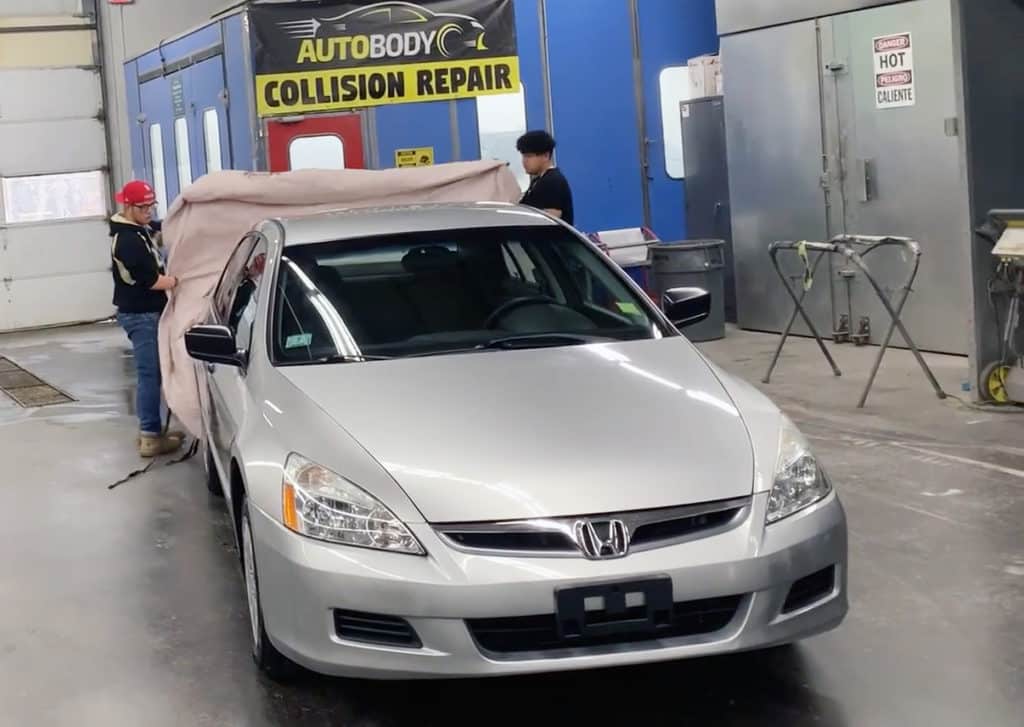
Northeast Metro Tech college students unveil a refurbished 2006 Honda Accord for a refugee from Afghanistan in collaboration with Next Probability Vehicles. (Courtesy Next Likelihood Cars via Northeast Metro Tech)

WAKEFIELD — Superintendent David DiBarri is delighted to announce that Northeast Metro Tech Automotive Technology learners repaired a auto that was donated to a refugee from Afghanistan by using the non-revenue business Second Probability Cars.

The refugee immigrated to The united states soon after assisting U.S. forces throughout the war in Afghanistan, and can not be named or photographed. He been given assistance from Second Opportunity cars to assistance him get to work and to transport a young child.

The refugee, considering the fact that coming to The united states on a military transportation airplane and then settling in Massachusetts, experienced been finding to perform at his night time-change work working with motor vehicle-sharing expert services, the expense of which was unsustainable.

Thanks to the refurbished 2006 Honda Accord he was offered by Next Possibility Autos, the refugee is now driving himself to work, conserving dollars, and has even been able to decide up additional time to enhance his family’s cash flow. 

Pupils in the Northeast Metro Tech automotive section fixed the car’s entrance bumper deal with, rear bumper reinforcement, and produced plastic repairs to a rocker panel cover. They also refinished each bumpers and the trunk lid employing the skills they’ve discovered in their pathway.

Among the the college students who did the most operate on the automobile are juniors Emilio Alfaro, of Revere, and Antonio Hernandez, of Chelsea, and sophomores Zayleah Carmenatty, of Chelsea, and Isabel Archilla, of Chelsea. Instructors Robert MacGregor, Dan Pero and Sal LaFauci oversaw the function.

The Accord was the fourth car or truck that Northeast Metro Tech learners have refurbished in collaboration with 2nd Prospect Autos, a Harmony-based mostly nonprofit that delivers refurbished, inexpensive employed cars and trucks to lower-cash flow veterans and some others so they can get to get the job done.

“Dan Holin and his business have offered us the great possibility to enrich the collision mend studying activities of our pupils by incorporating an component of assistance to the local community,” mentioned Collision Fix and Refinishing Department Head Robert MacGregor. “I particularly really like that the college students get to take part in the awarding of the automobile to see to start with-hand the influence their perform and achievements have on the recipients. I believe that the encounter offers a greater sense of relevance and intent to their get the job done, and a more powerful connection to their group.”

“Northeast Metro Tech pupils and staff enable us to correct the donated automobiles we get professionally but extremely affordably,” said Dan Holin of 2nd Opportunity Carrs. “We practically could not fulfill our mission of having excellent individuals to perform with no their assist!”

TECH TUESDAY: Under the bodywork of Mauro Forghieri’s masterpiece – the Ferrari 312T

TECH TUESDAY: Under the bodywork of Mauro Forghieri’s masterpiece – the Ferrari 312T

Mauro Forghieri, legendary Ferrari designer of the 1960s and 70s, handed absent very last 7 days, aged 87. In this week’s Tech Tuesday, Mark Hughes takes a near search at the Italian’s very best get the job done, the 312 line of Grand Prix and championship-successful Ferraris.

Not like most of the British designer contemporaries who came to prominence in the kit vehicle period and established chassis about the Cosworth DFV motor, Forghieri was also an engine designer.

OBITUARY: Mauro Forghieri, technological genius behind some of Method 1’s best Ferraris, remembered

His flat-12, made in co-procedure with his Ferrari colleague Franco Rocchi, powered the crew as a result of the 1970s to four constructors’ championships.

When this engine was installed in Forghieri’s 312T chassis for 1975, so was developed maybe the crowning accomplishment of Forghieri’s extensive job. It was a auto which would go on to dominate the period in the fingers of Niki Lauda.


FERRARI-PROFILI-EVOLUZIONE-B3-T.jpg

In this article we see the evolution of Ferrari from 1973-75, commencing with the first unsuccessful Colombo 312B3 of ’73, Forghieri’s modification of that car to aspect radiator spec at the Austrian GP of that yr and the steady refinement of Forghieri’s centralised mass theme represented by the ’74 edition of the 312B3 and the 1975 312T.

Ironically, it was from a moment of disaster in Ferrari historical past which despatched Forghieri on this route. In 1973, with Enzo Ferrari struggling ill-health, Forghieri experienced been assigned by mother or father enterprise Fiat to special initiatives and the initial F1 automobile of that yr was built by Sandro Colombo, albeit continue to employing the Forghieri flat-12 motor. Rather a radical departure in layout for Ferrari, with a short wheelbase and wedge-shaped monocoque, it was disastrously uncompetitive.

By the summer time, Enzo Ferrari’s wellbeing was bettering and upon retaking command, he introduced Forghieri back again from his exclusive projects where he experienced been doing work on a prototype regarded as the ‘snowplough’ for its distinctive nose, extensive system and incredibly short wheelbase.

Study Extra: Under the bodywork of the Ferrari 312B3 on the anniversary of Niki Lauda’s 1st F1 gain

Upon getting introduced again to the racing section Forghieri utilized the basis of his research with the snowplough to modify the Colombo motor vehicle, the 312B3. He introduced a unique-searching airbox superior driving the cockpit to much better feed the flat-12, allowing it to breathe far better.

He also relocated the radiators to the sides, guiding the shoulders of the driver (previously the drinking water radiator experienced been in the nose and the oil radiator beneath the rear wing). He was seeking to centralise the car’s masses to give it far better directional response, a topic he would go on to pursue and would in the long run direct to the transverse gearbox on the 312T, a initially for F1.


CONFRONTO-B3-STAND-B3-fORGHIERI.jpg

The key variations Forghieri built to the unsuccessful 1973 312B3 pointed the way to the dominant 312T of two several years afterwards. The radiators (formerly entrance and back again) have been moved to the sides, the oil tank relocated and the rear wing provided a significantly cleaner presentation for the airflow.

But prior to the 312T arrived a more modified edition of the 312B3, for 1974, nonetheless applying the ’73 car’s monocoque. This was the auto with which new recruit Niki Lauda would choose nine pole positions that calendar year and return Ferrari to the ranks of race winners.

It was a wonderful refinement of that prototype ’73 B3, taking fuller benefit of the aspect radiators to smooth the entire body sides and to raise the gap beneath the rear wing, to function it tougher. The area freed up at the entrance he used to incorporate a substantially greater delta-shaped wing.

He elevated the height of the airbox and – like his snowplough prototype – he built the bodywork very huge. He experienced found from his time planning Ferrari’s sporting activities racers (312P diagram, below) that the added bodywork, when operate near to the ground, enhanced downforce. Short and large, it appeared as very good as it went.

Look at: Top 10 – Moments of Niki Lauda Brilliance


312--P--1972.jpg

A cross-section of the Forghieri-developed 312P sports automobile

With the following year’s 312T (3-litre, 12 cylinder, Transversale) he centralised the car’s masses even further with that sideways-sited gearbox.

In other respects it was a even further refined version of the ’74 B3, with the radiators now laid extra horizontally, allowing a wonderfully cleanse sidepod design which built-in improved with the higher bodywork. The front suspension, as an alternative of being mounted on a subframe was now hooked up straight to the front of the bulkhead from which long, classy rocker arms prolonged out to the wheels.

Go through Additional: Lauda’s barely plausible Monza comeback

With Forghieri’s flat-12 creating additional electricity than the rival Cosworth DFV, the 312T could typically carry a lot more wing than the most effective Cosworth vehicles and in Lauda’s hands it grew to become practically unbeatable. It ongoing profitable races into the early element of 1976 right after which it was replaced by the 312T2 – fundamentally the similar automobile but modified to meet new dimensional needs from the Spanish Grand Prix onwards and the banning of airboxes. This car or truck took Lauda to his 2nd world title in 1977.

Forghieri developed many excellent Ferrari F1 and sports racers, but the 312T probably stands as the epitome of his genius.


FERRARI-312T--WC-1975-POSTER-.jpg

The 1975 312T (above) and the 312T2 (below) which was basically the same automobile but modified to meet the new dimensional polices from the 1976 Spanish Grand Prix onwards.