1985 Saab 900 Turbo Test: Replacement for Displacement

1985 Saab 900 Turbo Test: Replacement for Displacement

From the December 1984 issue of Car and Driver.

Who would have thought ten years ago that 1985 would reveal a production-car engine with a turbocharger, an intercooler, double overhead camshafts, four valves per cylinder, and digital-computer-con­trolled fuel injection? Even Formula 1 en­gines didn’t enjoy all of these features back then. The fuel crisis was in full swing, and more and more emission controls were being heaped on automobile powerplants. Vibrant and powerful engines were the last thing we expected from the future.

Yet here we have the new Saab 900 Tur­bo, equipped with all the aforementioned hardware. It’s smog legal, it delivers good fuel economy, and it chums out 160 hp from a modest 1985 cc of displacement. The small Swedish company arrived at this pinnacle of engine technology by steadfast­ly pursuing higher engine output, without allowing the fuel efficiency or the curb weight of its car to suffer.

The first step was adding a turbocharger to the corporate four-cylinder in 1978. Such a move may seem run of the mill to­day, but at the time there were only two tur­bo cars in production: Porsche’s 930 and Buick’s Regal. In 1982, Saab advanced the turbocharging art with its APC (automatic performance control) system, which mod­ulates turbo boost to control engine knock, thereby allowing a higher compression ratio, improved off-boost performance, and greater fuel efficiency.
1985 saab 900 turbo

Dick Kelley|Car and Driver

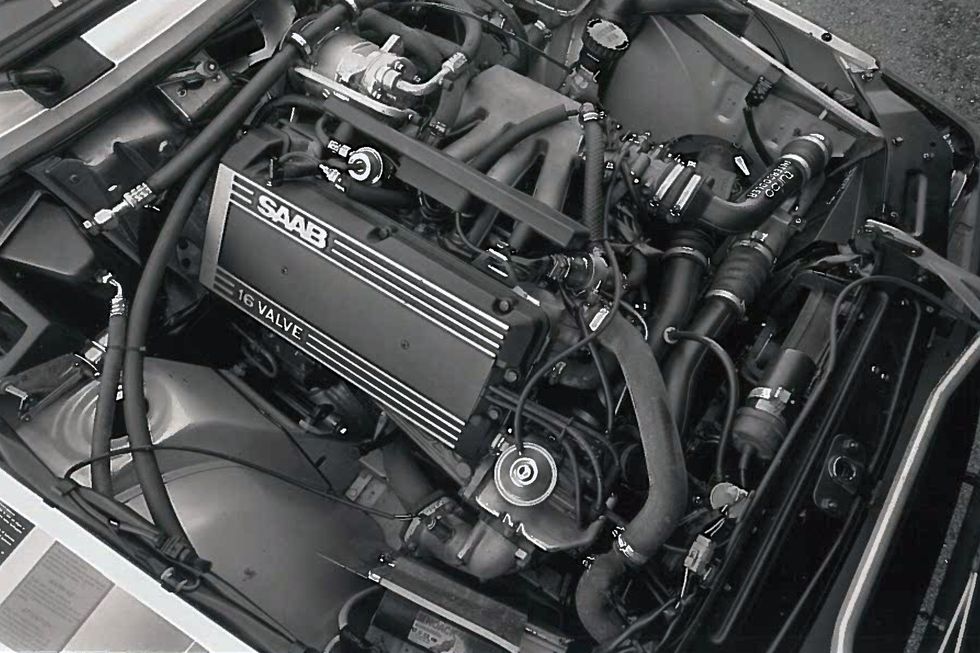
Now we have a third-generation Saab turbo motor, incorporating wholesale de­sign improvements. The most important is a new four-valves-per-cylinder head. The valves are actuated by two chain-driven overhead camshafts via bucket tappets with integral hydraulic lash adjusters. With two 32.0 mm-diameter intake valves and two 29.0 mm exhaust valves per cylinder, the engine breathes more freely than it did through a single 42.0 mm intake and a 34.5 mm exhaust valve, even though valve lift is slightly reduced and the duration of the valve events is about the same. The an­gle between the intake and exhaust valves is only 44 degrees, which yields a compact, pent-roof combustion chamber. The spark plug is centrally located and the double in­take port induces high turbulence, so flame travel is short, combustion is quick and complete, and there is little tendency to­ward detonation.

Taking one more step to minimize knocking, Saab engineers shoehorned an intercooler into the 900’s cramped engine compartment. As a result, the sixteen-valve engine’s peak boost pressure was raised to 10.9 psi (from the 9.4 psi of the eight-valve engine), and the compression ratio was bumped up half a point, to 9.0:1—higher than the compression ratios of most nor­mally aspirated engines. The healthy com­pression and the freer breathing improve the engine’s output both on and off the boost, while the intercooler and the elevated boost pressure move peak output up an­other notch.

Saab has also taken this opportunity to switch from Bosch K-Jetronic mechanical to Bosch LH-Jetronic electronic fuel injec­tion. The new system’s microprocessor controller allows more exact and elaborate regulation of the fuel injection, and a hot­wire airflow sensor comes with the pack­age. This transducer offers less flow re­striction, automatic altitude compensation, and a more precise measure of the intake-air mass.
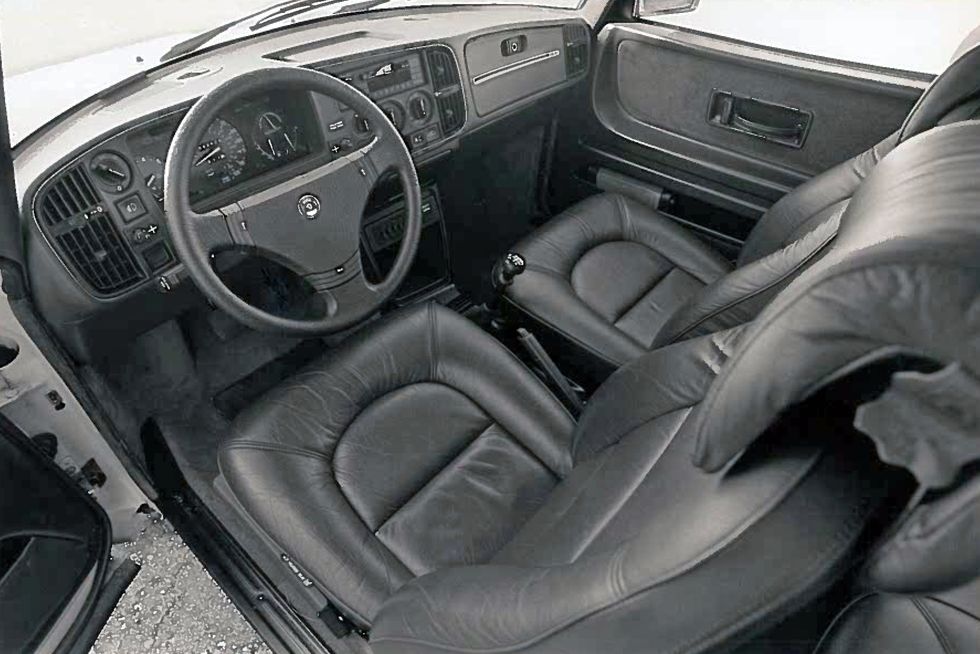
1985 saab 900 turbo

Dick Kelley|Car and Driver

Thanks to all the new technical exotica, Saab’s star engine now develops 160 hp at 5500 rpm and 188 lb-ft of torque at 3000 rpm, compared with the old powerplant’s 135 hp at 4800 rpm and 172 lb-ft at 3500 rpm. Not only is the output substantially greater, but the spread between the power and torque peaks has increased from 1300 to 2500 rpm, signifying a much more flexible engine. Amazing­ly enough, these increases in output have not been achieved at the expense of EPA fuel economy.

Driving the new Saab brings these bene­fits into sharp focus. The new car is notice­ably quicker than prior versions, and it also seems more relaxed. The sixteen-valve en­gine revs so effortlessly that we found our­selves constantly going faster than expect­ed. Part of the engine’s good nature is its silky smoothness: The Saab sixteen-valve never emits a coarse quiver or a discordant grind. The rest is simply the joy of a healthy torque curve—once the boost is up, this en­gine positively charges for the redline.
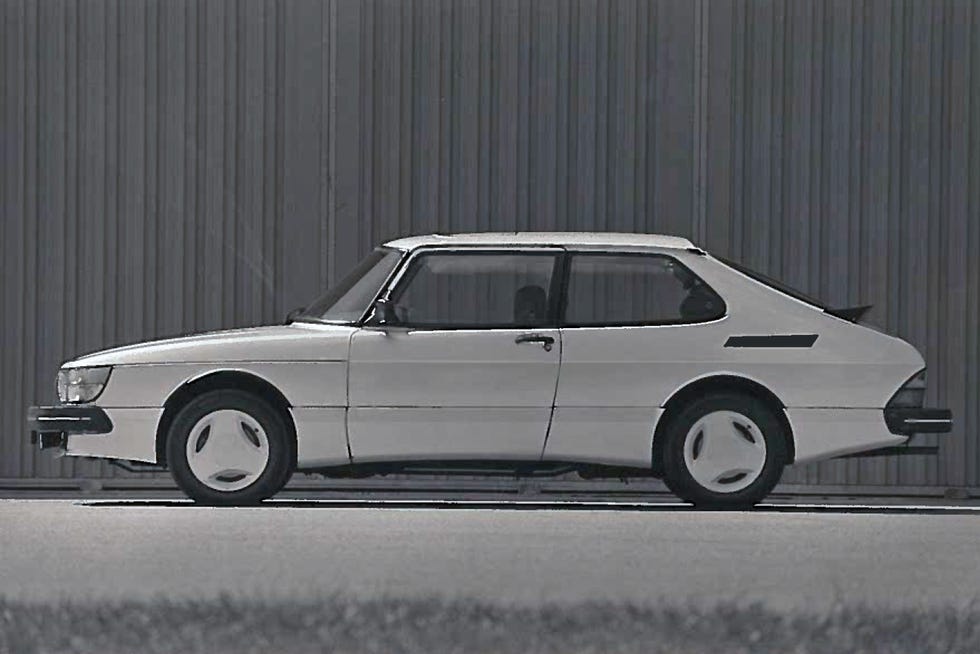
1985 saab 900 turbo

Dick Kelley|Car and Driver

The only hardship is waiting for the boost. Despite all the mechanical and elec­tronic improvements, Saab hasn’t done much to make the turbo spin more quickly up to speed. The off-boost performance has indeed been improved, but so has the on-boost output, leaving the margin be­tween the two as great as ever. The boost builds slowly below 2500 rpm, as it does in eight-valve Saabs. Above 3000 rpm, how­ever, throttle response is immediate, even in top gear.

When full use is made of the upper rev range, the sixteen-valve Turbo scoots from 0 to 60 mph in 8.5 seconds, about 0.8 sec­ond quicker than the old car, and covers the standing quarter-mile in 16.5 seconds at 83 mph, a half-second quicker than be­fore. The difference would probably be greater but for the Saab’s traditional prob­lem of wheel hop during hard starts. The tires do stay in contact with the earth at higher speeds, so the 900 Turbo’s peak ve­locity jumps from 113 to 128 mph, making it one of the fastest sedans sold in America.

Our Saab’s high-speed talents were helped by its aerodynamic body panels, which are part of the optional Special Per­formance Group. These add-ons reduce the drag coefficient from just over 0.40 to just under 0.40 (according to Saab) and give the car a sleeker, if still blunt, appear­ance. The package also includes leather upholstery, an electric sunroof, fog lights, special three-spoked alloy wheels, V-rated tires, slightly softer rear shock absorbers, and front and rear anti-sway bars (the first such devices ever fitted by the factory to a 900). Our test car was painted a lustrous pearl white, but production versions with this package will come only in black.
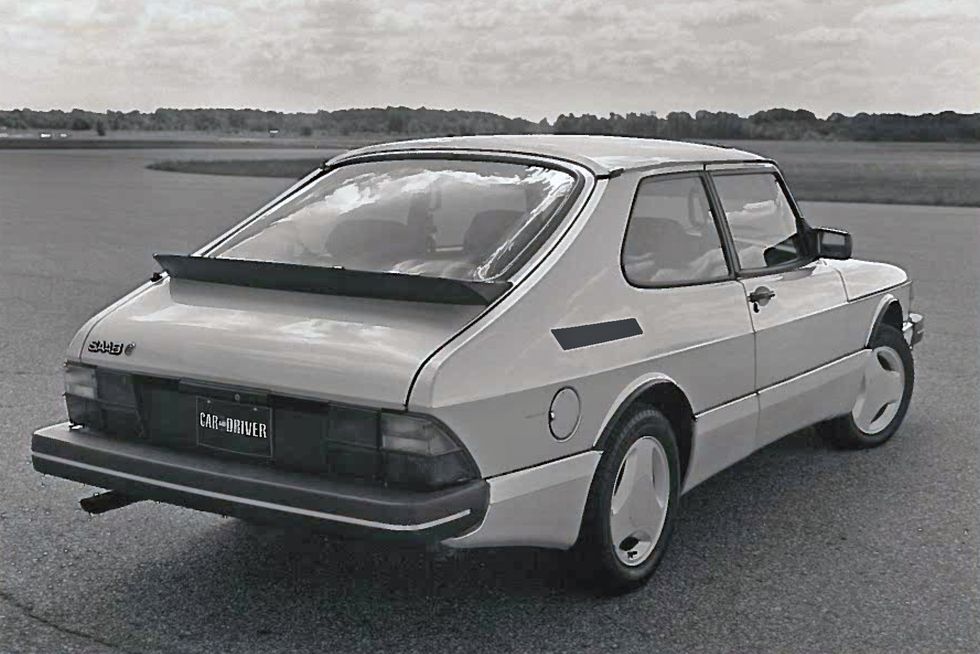
1985 saab 900 turbo

Dick Kelley|Car and Driver

The suspension pieces admirably com­plement the more powerful engine. They keep the Saab more upright in hard cor­ners and give it very neutral handling, with understeer and oversteer controlled by the driver’s right foot. Yet, despite the suspen­sion’s tauter and more precise feel, ride comfort seems no worse than before. And the lack of torque-steer effects sets the standard for other powerful front-drive cars to emulate.

For 1985, all 900 Turbos sent to Ameri­ca will have the sixteen-valve engine. In the three-door configuration, they’ll carry a base price of $18,150. The Special Perfor­mance Group costs a hefty $2860 more, a penalty we’d like to see Saab ease by mak­ing the suspension components available separately.

Expensive or not, the new 900 Turbo is unquestionably the best Saab ever—as sol­id and practical as always, but now bristling with remarkable performance as well. The upcoming 9000 has a tough act to follow.

Arrow pointing downArrow pointing down

Specifications

Specifications

1985 Saab 900 Turbo
Vehicle Type: front-engine, front-wheel-drive, 5-passenger, 3-door sedan

PRICE

Base/As Tested: $18,150/$21,010
Options: Special Performance Group (leather upholstery, electric sunroof, fog lights, V-rated tires, anti-sway bars, aerodynamic aids, special wheels, special shocks), $2860; black paint, $385.

ENGINE
turbocharged and intercooled DOHC 16-valve  inline-4, iron block and aluminum head, direct fuel injection

Displacement: 121 in3, 1985 cm3

Power: 160 hp @ 5500 rpm

Torque: 188 lb-ft @ 3000 rpm 

TRANSMISSION
5-speed manual

CHASSIS

Suspension, F/R: control arms/live axle

Brakes, F/R: 11.0-in disc/10.6-in disc

Tires: Pirelli P6
195/60VR-15

DIMENSIONS

Wheelbase: 99.1 in

Length: 186.6 in

Width: 66.5 in
Height: 56.1 in

Passenger Volume, F/R: 46/42 ft3
Cargo Volume: 22 ft3
Curb Weight: 2908 lb

C/D TEST RESULTS
30 mph: 2.6 sec
60 mph: 8.5 sec
1/4-Mile: 16.5 sec @ 83 mph
100 mph: 29.6 sec

Top Gear, 30–50 mph: 11.8 sec

Top Gear, 50–70 mph: 10.0 sec

Top Speed: 128 mph
Braking, 70–0 mph: 217 ft

Roadholding, 300-ft Skidpad: 0.75 g

C/D FUEL ECONOMY
Observed: 20 mpg

EPA FUEL ECONOMY
City/Highway: 19/26 mpg 

C/D TESTING EXPLAINED

Headshot of Csaba Csere

Contributing Editor

Csaba Csere joined Car and Driver in 1980 and never really left. After serving as Technical Editor and Director, he was Editor-in-Chief from 1993 until his retirement from active duty in 2008. He continues to dabble in automotive journalism and LeMons racing, as well as ministering to his 1965 Jaguar E-type, 2017 Porsche 911, and trio of motorcycles—when not skiing or hiking near his home in Colorado. 

Here’s What You Get on a Fully Loaded Mazda CX-90 Inline 6 Turbo

Here’s What You Get on a Fully Loaded Mazda CX-90 Inline 6 Turbo
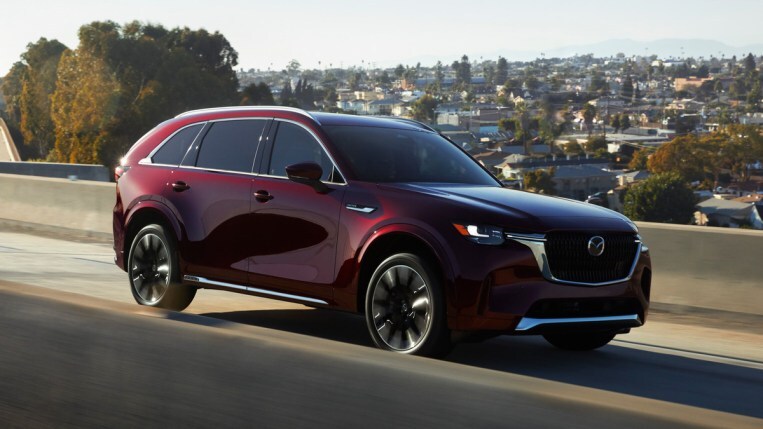
2024 Mazda CX-90 driving on the highway.Every single automaker builds a flagship – a car or truck that reveals the finest of what they can do. It’s generally the most high-priced issue in the showroom, often the major, and constantly amazing.
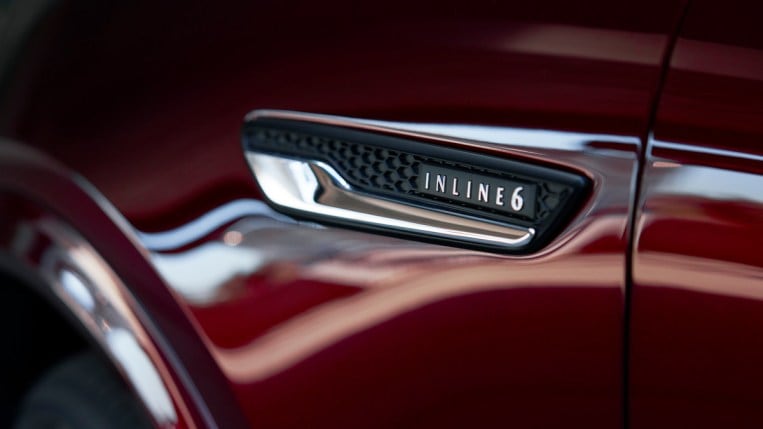
Mazda has an all-new a person for 2024. The 2024 Mazda CX-90 arrives with a decision of two powertrains. A single is Mazda’s first hybrid – a plug-in hybrid (PHEV) version we’ll include independently.

The other makes use of a powertrain popular to luxury vehicles – a turbocharged inline 6-cylinder motor mated to an all-wheel-generate (AWD) technique biased towards the rear wheels. It’s a set up regarded for smoothness and crisp handling.

Mazda will offer you the CX-90 in eight trim degrees. The leading-of-the-line 3.3 Turbo S Top quality As well as carries a luxury car’s price tag – commencing at $59,950 – and earns it with grand furnishing and all the makings of a great general performance motor vehicle.

340-Horsepower Turbo Engine

Mazda will give two different “straight six” engines on the CX-90. The standard edition has very little to be ashamed of, with 280 horsepower. But the Turbo S Quality Moreover gets a extra powerful, 340-horsepower variation.

Straight-6 engines are regarded for their superb equilibrium and smooth electric power supply. And 340 horsepower is a usual determine for the luxurious classes, outdueling everything Toyota or Honda puts in a utility vehicle and landing firmly in the territory of midsize SUVs from BMW and Audi.

2024 Mazda CX-90 engine badge.

Rear-biased i-ACTIV AWD Procedure

We haven’t had the likelihood to travel the CX-90 but (no one in the automotive press has as of this crafting), so we simply cannot vouch for how it handles.

But it has a promising setup. Mazda’s AWD procedure sends extra power to the rear wheels in day-to-day driving, going that power to the entrance only when needed for extra grip. That gives you the day-to-working day really feel of a rear-wheel-travel motor vehicle like fanatics appreciate, but serious cold-weather security. Incorporate it with Mazda’s Kinematic Posture Handle procedure for extra dealing with harmony, and the CX-90 has the technical specs of a fun-to-push SUV.

Deluxe Appointments

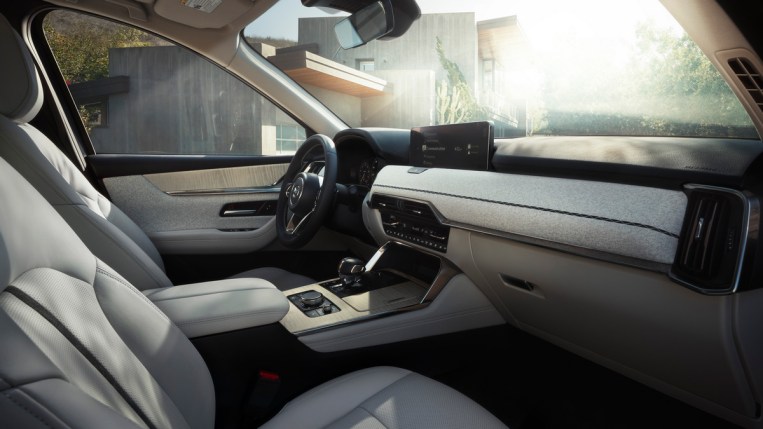
Most automakers can give you leather. With the CX-90, Mazda will provide you Nappa leather-based – a finer quality of conceal that goes via extra softening methods in the tanning procedure. The front seats are 8-way electrical power-adjustable, heated, and ventilated. So, remarkably, are the second-row seats.

3-zone automatic local climate control with a pollen filter, LED accent lighting through, and a 12.3-inch entire-color heart touchscreen show (bigger than the 10.25-inches of the entry-level trim) make the CX-90’s cabin feel a lot more upscale than you could assume from what is traditionally considered a mainstream manufacturer.

2024 Mazda CX-90 interior passenger side.

Thoughtful Design

It’s not just the elements, nevertheless. It is how thoughtfully they’re assembled.

Some automobiles feel nicely-produced. Some others experience crafted. The CX-90 pushes Mazda into new territory. We’re notably fond of, oddly adequate, the stitching on the dashboard.

Tone-on-tone oatmeal-coloured dashboard fabrics are nicely established off by hanging stitches — “specifically influenced by hand-bookbinding and an intricate Japanese weaving technique acknowledged as Kumihimo,” Mazda claims. We’ve never ever viewed it on an additional car, which can make it sense specific.

Those people Nappa leather-based seats have quilting, which will make them seem more complex.

Basic safety Tech

The Mazda CX-90 3.3 Turbo S Premium Plus will come with a whole suite of modern day security aids. That incorporates sophisticated driver assists like radar cruise handle with quit and go and computerized speed restrict assist, and lane-preserving guide that can flippantly help steering to support retain you centered in your lane. It is not fairly the self-driving automobiles of the long run, but it can be very helpful on very long freeway drives.

Far more Mazda CX-90

Browse our total assessment or create and selling price your personal Mazda CX-90. If you are completely ready to choose some motion, verify out the Mazda CX-90 styles for sale near you.

Paul Newman’s Turbo Volvo 740 is an Expensive Brick

Paul Newman’s Turbo Volvo 740 is an Expensive Brick

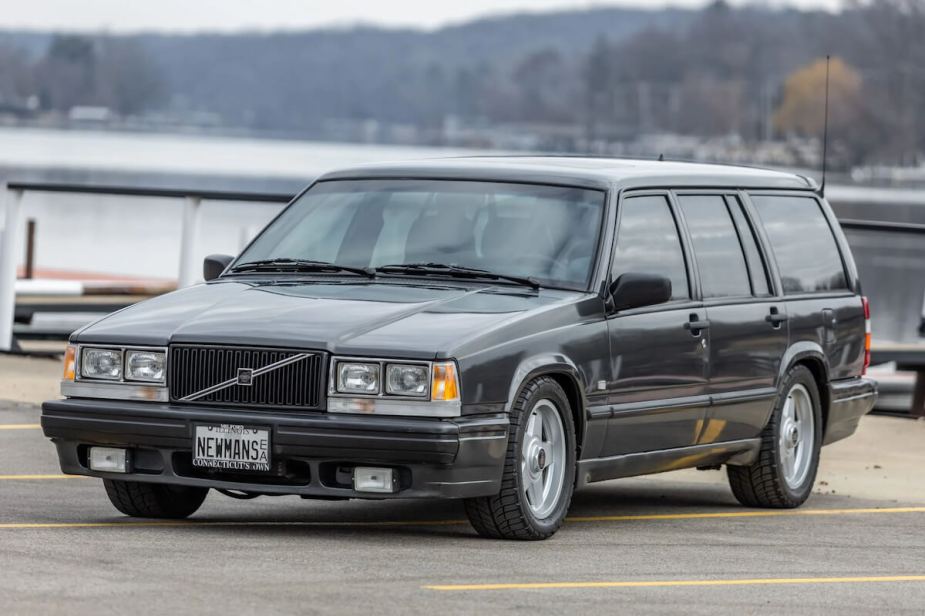
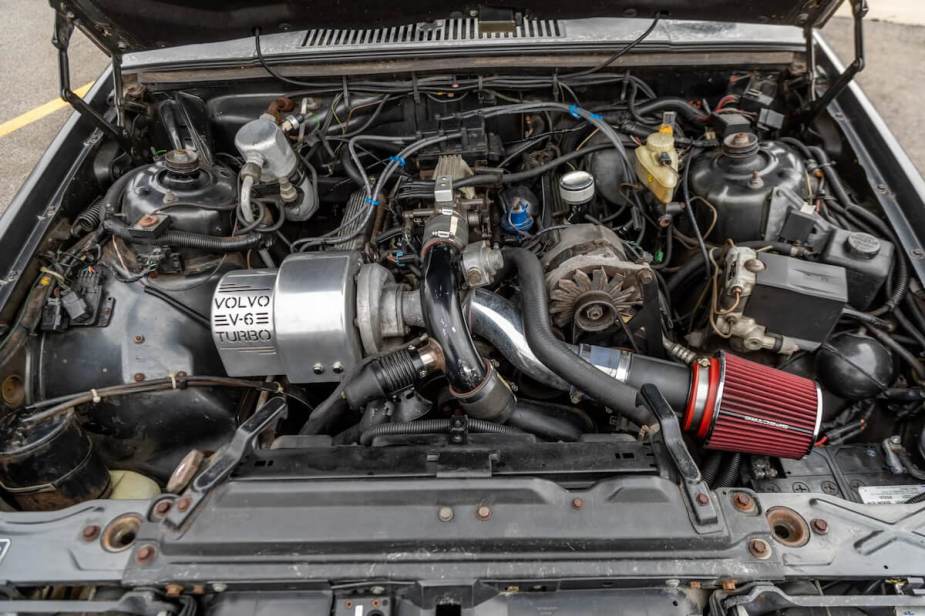
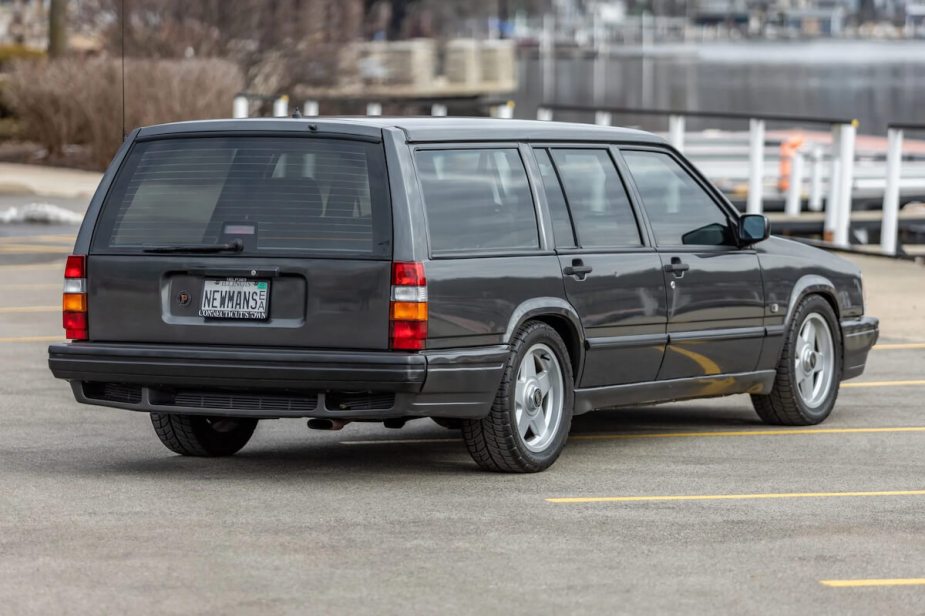
Paul Newman was not just a legendary actor but also a passionate automobile fanatic and a profitable racing driver. A person of the vehicles in his spectacular assortment was a 1988 Volvo 740 Turbo, which he swapped an interesting motor into. This specific Volvo 740 is now up for sale, and its special background and modifications make it a sought-immediately after motor vehicle. This short article will consider a closer glimpse at Paul Newman’s Turbo Volvo 740.

What motor is in Volvo 740 Turbo?

1988 Volvo 740 Turbo
Paul Newman 1988 Volvo 740 | Carry A Trailer

The Volvo 740 was out there with various engine alternatives from 1984 to 1992. The most common engine was a 2.3-liter inline-four-cylinder engine that developed among 113 and 162 horsepower, based on the product calendar year and particular motor configuration. Having said that, the motor in Paul Newman’s 740 wagon was from a distinct auto.

2023 Hyundai Alcazar launched with new turbo petrol engine: Priced from Rs 16.75 lakh

2023 Hyundai Alcazar launched with new turbo petrol engine: Priced from Rs 16.75 lakh

The 2023 Hyundai Alcazar has been released in India at a beginning price of Rs 16.75 lakh, ex-showroom. It will get a brand name new 1.5-litre turbo petrol engine and a host of basic safety attributes as conventional fitment across the selection.

Hyundai Motor India has announced the prices of the up to date Alcazar a few-row SUV. The 2023 Hyundai Alcazar has been introduced in India at a starting up selling price of Rs 16.75 lakh, ex-showroom. It is the 1st Hyundai vehicle to get the company’s new 1.5-litre turbocharged petrol motor. The variant-sensible price ranges of the Alcazar are outlined in the desk below. 

hyundai alcazar features

2023 Hyundai Alcazar petrol: Variant-sensible prices 

Alcazar 1.5-litre turbo petrol variant Price tag (ex-showroom)
Prestige MT 7S Rs 16.75 lakh
Platinum MT 7S Rs 18.65 lakh
Platinum (O) DCT 7S Rs 19.96 lakh
Platinum (O) DCT 6S Rs 19.96 lakh
Signature (O) DCT 7S Rs 20.25 lakh
Signature (O) DCT 6S Rs 20.25 lakh

The new 2023 Hyundai Alcazar petrol is provided in 3 trim degrees: Prestige, Platinum and Signature, distribute throughout six variants. It has been priced from Rs 16.75 lakh to Rs 20.25 lakh, ex-showroom, and is out there in both of those six and seven-seater versions. It will rival the likes of the MG Hector As well as, Toyota Innova Crysta, Mahindra XUV700, etcetera.  

Also Read through: 2023 Yamaha FZ-X First Journey Evaluate: What is New?

hyundai alcazar price

2023 Hyundai Alcazar: Motor and gearbox

Powering the 2023 Hyundai Alcazar is an all-new 1.5-litre turbo petrol motor that develops 158 bhp and 253 Nm of peak torque. The engine arrives mated to a 6-velocity manual gearbox and a 7-velocity DCT. It also will get a 1.5-litre diesel engine that churns out 113 bhp and 250 Nm, paired with a 6-velocity MT and a 6-velocity AT. Equally the engines are RDE-compliant and E20 gas completely ready.

Comply with: Categorical Drives on InstagramTwitter, and Fb

2023 hyundai alcazar

2023 Hyundai Alcazar: Attributes and basic safety

The 2023 Hyundai Alcazar receives basic safety options like 6 airbags, all-wheel disc brakes, Stomach muscles, EBD, reverse parking sensors, TPMS, Electronic steadiness control, Motor vehicle stability administration and Hill commence help management as normal across all the variants. In phrases of characteristics, it receives a 10.25-inch touchscreen infotainment process with Android Car, Apple CarPlay and linked auto tech, a digital instrument cluster, and many others.

Observe Online video | Hyundai Alcazar Review:

Also Read: Top 5 most inexpensive electrical cars in India: Tiago EV to XUV400

Keep tuned with Specific Drives for extra updates and also, do subscribe to our YouTube channel for the hottest car information and evaluations.

GM Has Apparently Canceled its Rumored Turbo Straight-Six

GM Has Apparently Canceled its Rumored Turbo Straight-Six

2022 Chevy Suburban Diesel

2022 Chevy Suburban Diesel
Impression: Chevrolet

The auto industry’s transition to electrical autos hasn’t particularly stopped gasoline motor growth. Even however the foreseeable future may well be electric powered, gasoline engines will even now be about for a long time, and automakers are continue to trying to build new, additional effective inner-combustion powerplants Evidently, at the very least one particular of these has gotten the axe: GM Authority experiences that General Motors has canceled development of an all-new turbocharged straight-6 engine which is been rumored for some time.

Last 12 months, it was noted that this new straight-six motor was in the scheduling levels. It was recommended that it would be crafted from the 2.7-liter turbocharged inline-four at the moment made use of in sure trims of the full-measurement Chevy Silverado / GMC Sierra as effectively as the all-new Chevy Colorado and approaching upcoming-gen GMC Canyon. That engine tends to make 237 hp in primary tune, or 310 hp in substantial-output trim in the Colorado.

This straight-six evidently would have made all those numbers pale in comparison. Sources say that GM was capturing for 500 hp and 500 lb-ft of torque. Those people numbers would have outgunned both of those of GM’s compact-block V8 truck engines, the 5.3-liter and the 6.2-liter. As the rumor goes, the straight-6 would have noticed duty in GM’s full-dimension pickups as properly as their SUV variants, particularly the Tahoe, Suburban, Yukon and Escalade.

When arrived at by Jalopnik, a GM representative would not confirm that the turbo straight-6 had ever been underneath growth, and would not remark on the rumor that it had been canceled.

If the rumored motor has actually been axed for great, GM may well come to regret that selection. Competing vehicles and SUVs from Ford, Stellantis and Toyota have all extra turbocharged 6-cylinder alternatives lately. The Toyota Sequoia at present provides a twin-turbo hybrid V6 Ford has been making use of Ecoboost V6s in the F-150, Expedition and Navigator for several years and Stellantis offers the Jeep Wagoneer with a new 3.-liter 510-hp twin-turbo straight 6.

Prospective buyers seeking something new or distinctive in their GM body-on-frame models might now have to wait until eventually the Standard unveils its next generation of small block V8s, or go with the company’s 3.-liter Duramax turbodiesel. In a way, it’s a disgrace — with people rumored specs, GM’s straight-six motor could have easily been competitive with the greatest boosted sixes on the current market nowadays.

Proton X90 confirmed to get 48V hybrid turbo engine

Proton X90 confirmed to get 48V hybrid turbo engine

Proton’s extremely to start with output hybrid motor vehicle will be launched this year, according to reviews by research residences centered on an analyst briefing by Proton’s majority shareholder DRB-HICOM on March 2. In accordance to these reviews, the Proton X90 will be a gentle hybrid electrical car (MHEV).

The MHEV hybrid process is anticipated to be a 1.5 litre 3-cylinder 48V engine+motor combo manufacturing 190 PS at 5,500 rpm and 300 Nm of torque from 1,500-4,000 rpm, which is larger than the 177 PS, 255 Nm non-hybrid model of the engine.

We experienced presently speculated that this would materialize dependent on two explanations. First of all, Proton has now exhibited this engine at Proton’s Centre of Excellence showroom in Shah Alam back again in November 2021. Next, this motor is previously remaining applied by the Proton X90’s ‘sibling’, the Geely Okavango in the still left hand travel Philippines sector.

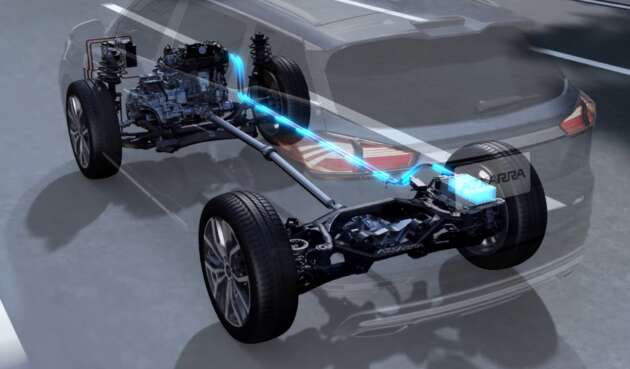
How does the Proton X90’s 48V hybrid procedure get the job done?

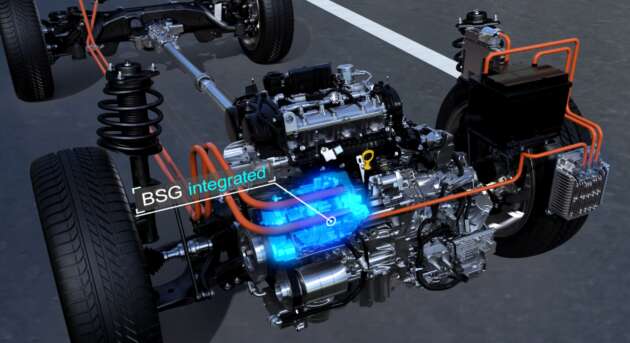
The process takes the standard 3-cylinder 1.5 litre turbocharged motor and adds a range of parts to it. The hybrid program can present 13 horsepower and 45 Nm of guide, which is what provides the 177 PS, 255 Nm quantities of the non-hybrid up to 190 PS and 300 Nm in the hybrid.

The electric powered aid in this process is presented by a BSG, or Belt-pushed Starter Generator. It’s fundamentally an exceptionally beefed up alternator that can be employed to deliver some ability to the motor.

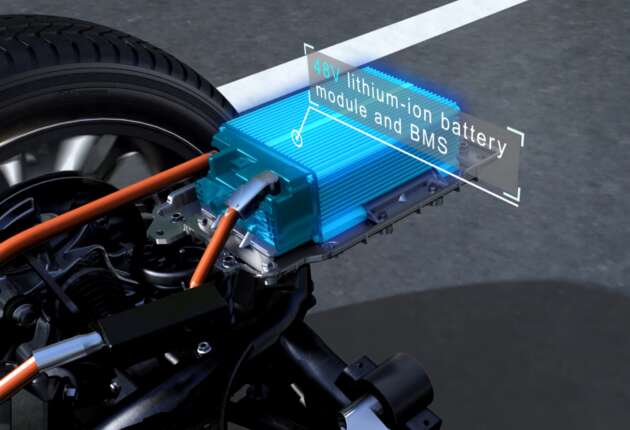
Compared with other much more elaborate hybrid programs which sandwiches a motor involving the engine and the gearbox, the BSG offers electrical power via the belt, which is connected to the crank. It operates on a 48V energy procedure, supplied by a 48V battery.

The BSG will also be in a position to demand this 48V battery by recuperating braking vitality and turning it into electricity. This is the only way to charge the battery, as there’s no socket for exterior charging.

There is also a 48V to 12V DC to DC converter in the program, so the 48V program can supply energy to the car’s regular 12V process, which runs everything else like the aircond and lights.

Given that it is named a ‘mild’ hybrid procedure, the abilities are also ‘mild’. The Proton X90’s hybrid BSG motor will not be in a position to electricity the car on pure electric powered travel method like other additional innovative systems like Honda’s e:HEV procedure or Toyota’s Hybrid Synergy Drive systems.

What it will be equipped to do is enable the Proton X90 hybrid to have prolonged engine shutdown at speeds of under 15 km/h, such as when coasting to a prevent. The 13 hp and 45 Nm also kicks in when you are accelerating from a halt or even in the course of overtaking moves, offering extra torque when you need to have it the most. The Proton X90 can also coast at freeway speeds with the engine shut off and the gearbox disconnected.

48V hybrid programs are on the uptrend these days and they are basically much more commonplace in the showrooms than you assume, but they’re just not promoted as hybrids any longer specially with premium brand names and/or very first planet nations around the world as the market has transitioned to utilizing the term only for more intricate hybrid methods.

For example, equally the Malaysian current market W206 Mercedes-Benz C200 and C300’s M254 engines use 48V hybrid units with BSG.

Are you thrilled for Proton’s very first 48V hybrid to strike the showrooms? Or are you additional adventurous and are waiting around for a plug-in hybrid like Volvo’s T8 hybrids in its place? Enable us know in the reviews.

https://www.youtube.com/look at?v=VWCOw9nGt2U

GALLERY: 2023 Proton X90 spyshots

GALLERY: Geely Haoyue/Okavango

Tags: Proton X90