How Electric Turbochargers Are Changing Internal Combustion

How Electric Turbochargers Are Changing Internal Combustion

Now more than ever, automotive engineers have to chase efficiency wherever they can. In an internal-combustion engine, a turbocharger is a great way to boost power and efficiency for an engine of a given displacement, and over the last decade we’ve seen a proliferation of downsized, turbo engines replacing larger naturally aspirated units. Yet, the turbocharger itself is far from perfect.

A turbocharger is a crude device. It takes a while to spool up, the spool is entirely dictated by the flow of exhaust gasses, it wastes a lot of those exhaust gasses, and it’s hot. Plus a traditional turbo can only be operated well below its maximum speed, because if it exceeds this, damage to the turbo and/or engine can occur.

An electric turbocharger can solve a lot of these problems, and more.

Let’s dip into a quick, perhaps unnecessary, sum-up of turbocharger basics. Within the snail-shaped housing are two turbines on either side connected by a small shaft. Exhaust gasses blow on one turbine, which in turn spins the other called the compressor wheel. The compressor wheel increases air density in the intake, boosting engine power. Fresh air also feeds the compressor, and typically, the air from the compressor goes through an intercooler of some sort to reduce intake air temperature. On the exhaust side, there is usually a valve that opens and sends excess air downstream to the rest of the car’s exhaust system once the turbine is up to a desired speed. This is called the wastegate.

garrett e turbo

Garrett Motion

An electric turbocharger is basically just a regular turbocharger with a motor attached to the turbine shaft. Simple in concept, difficult in execution, filled with possibilities. “It brings another degree of freedom, says Craig Balis, CTO at Garret Motion, in an interview with Road & Track. “Automakers can use it for power, they can use it for efficiency, they can use it for emissions, they can use it for drivability.”

Garrett has been in the turbo business for decades, and it was the first to bring an electric turbocharger to the market. Mercedes-AMG is the first automaker to offer it, in both the C43 and C63, which pair an e-turbo with AMG’s 2.0-liter M139 for 402 and a staggering 476 hp, respectively. The C63 has the most power-dense engine on the market today, with 251 hp/liter, and because enough is never enough, the four-cylinder is augmented by a plug-in hybrid system for 671 hp.

It’s easy to think that the sole job of an electric turbocharger is to reduce lag. That’s what I thought, and indeed, that is a huge benefit of its use. In very simple terms, a larger turbocharger—with larger turbine and compressor wheels—can force more air into an engine, making more power, but the bigger you go in turbo size, the longer it takes to achieve the target boost level. Add an electric motor to the shaft, however, and you can get the whole thing up to maximum speed without waiting on exhaust gasses. (Turbo lag cannot be eliminated but it can be reduced to such a small amount that it’s inconsequential.)

Balis prefers to use the term transient response—what happens when you press the accelerator—rather than turbo lag. He points out that improving transient response not only helps with drivability, but emissions too. “You’re able to control the air that goes into the engine more precisely, matching it with the fuel and the demand on the engine.”

garrett e turbo

Garrett Motion

Then, there’s the efficiency an e-turbo brings. An electric motor can spin in two directions, and spun in reverse, it can act as a generator. In hybrid and battery-electric vehicles, the slowing of the motors can be used to slow down the car while putting energy into the battery. On a much smaller scale, you can do the same thing with the motor of an electric turbo. “The funny thing about the turbo is over various drive cycles, typically it can be energy neutral,” Balis says. “Meaning you can generate as much as you use. It’s at different points in time, but over various drive cycles, it can become energy neutral, or even energy positive.”

Garrett’s electric turbo still uses a wastegate, though the more precise level of boost control means less exhaust gas is wasted, and thus, a smaller wastegate can be used. Having a motor on the shaft means that the precise speed of the turbo is always known. Typically, a modern car’s ECU estimates the speed of the turbo and uses the wastegate to manage boost pressure, but leaves a huge margin for error for safety and durability. This leaves performance on the table for a given turbocharger size. If you know the exact speed of your turbo, however, you can run it much closer to its operating limit without fear of exceeding it. It’s not a benefit unique to e-turbos—Ferrari and Nissan both use traditional exhaust-gas turbochargers with speed sensors—but it’s important to note.

2023 mercedes amg c 63 e performance

The new Mercedes-AMG C63.

Mercedes-Benz

Garrett started working on e-turbos 20 years ago, but found that they simply weren’t viable with 12-volt electrics. Balis says you could only have a 3-kW motor on the shaft at the maximum, and even then, it was a big draw on the system. With the rise of higher-capacity electrical architectures, electric turbocharging became viable. Most versions of the current C-Class use a 48-volt “mild-hybrid” architecture, while the C63 uses an AMG-designed 400-volt plug-in hybrid system. Mercedes also decided that the new C-Class would only receive four-cylinder power. Electric turbocharging made a lot of sense here.

According to Jan Habermann, one of the engineers behind AMG’s application of e-turbos, the company wanted to give the C43 a more special engine than its predecessor, which used a V-6 shared with non-AMG products. The M139 is made by hand at AMG’s factory in Affalterbach, and while it can be found in AMG’s 45-series cars, those have 12-volt electrics, and thus, traditional exhaust-gas turbochargers. The C43 gets the e-turbo not for more power—the CLA45 S makes 415 hp to the C43’s 402—but for all the other benefits the hardware brings.

mercedes c 63 powertrain

The Mercedes-AMG C63 powertrain.

Mercedes-AMG

The C63 represents a different story. Its four-cylinder plug-in powertrain replaced a much-loved 4.0-liter V-8, and AMG knew it had to pack a huge punch. “[Going] hybrid has a lot of advantages,” Habermann says. “You can have a very small and fuel-efficient engine on one side; you can drive fully electric, and you have really insane performance, much, much, much better than the predecessor.” AMG felt that the C63 had to not only compete with traditional gas-powered super-sedans but with new, ultra-powerful EVs. (In a world where Kia sells a 577-hp version of the EV6, you can see the logic.)

To get the sort of power out of a 2.0-liter turbo four AMG was after, Habermann says that you’d have “turbo lag like hell” with a traditional turbocharger. The C63’s turbo has a compressor wheel diameter of 71 mm to generate maximum boost of 37.7 psi (!), which is something you’d more likely see in a truck or a thousand-horsepower tuner car. It’s gargantuan. (It also has variable-geometry vanes, for even more flexibility.) You may think that the C63’s hybrid system, which has a 204-hp electric motor, could compensate for any turbo lag, so why go through the trouble of using an electric turbo? There’s not a simple answer.

“It’s again for performance and efficiency,” Habermann says. AMG’s hybrid system uses a 6.1-kWh battery and the idea behind the control strategy is to keep the battery plenished up enough so the motor can deliver full power whenever the driver wants. By using the electric turbo to get the engine to full power quickly, the electric motor can remain on standby with energy stored in the battery. “It’s a funny thing. You have an electric traction drive, but you do not want to use it so that you can store the energy. You just want to use it for performance.”

Funny as it might be, it’s easy to see the logic when you consider that the motor on the C63’s electric turbo has just 6 kW (8 hp), so it takes a lot less energy to spin that up than it does to spin a drive motor 25 times as powerful.

tecday amg future of driving performance eigenständige e performance antriebsstrategie für performance hybride antriebsstrang 4 zylinder m139 elektrischer abgasturbolader tecday amg future of driving performanceindependent e performance drivetrain strategy for performance hybrids drivetrain 4 cylinder m139 electric exhaust gas turbocharger

Cutaway of the e-turbo used in the C63.

MERCEDES-BENZ AG – GLOBAL COMMUNICATIONS MERCEDES-BENZ CARS & VANS

AMG naturally does a lot of interesting things with the turbocharger throughout the engine’s rev range. At low engine speeds, the motor spins the turbocharger up while pressure from exhaust gasses are still building. Since this increases the volume of air going into the engine, it also increases the volume coming out, further aiding boost generation. In and around 3500 rpm and at constant throttle, the motor doesn’t do much, if anything, as there is enough exhaust gas to keep the turbocharger spinning at its maximum of 175,000 rpm. At higher speeds, up to the C63’s 7000-rpm redline, however, the motor puts out around 1 kW to keep the turbo spinning, helping extend the power band and improving throttle response. Normally turbocharged engines “die out” closer to redline, but AMG wanted a turbo engine that felt more like a naturally-aspirated one, with power building across the rev band.

As you’d expect, AMG also uses the turbo’s motor to improve transient response across the power band, and as needed. Habermann says that at lower engine speeds it can take up to a second to reach full boost pressure, in the mid-range, it’s almost instantaneous, and at high RPM, it’s around 0.4 seconds. That’s impressive for such a large turbocharger, and small enough that you don’t feel it, according to Habermann. The turbo also sends energy back to the battery off throttle during gear shifts, harnessing the air that would otherwise be sent out of a wastegate back into the atmosphere.

Spare a thought for the calibration engineers, and the guys at AMG who have to make sure the bottom end of a 2.0-liter four-cylinder doesn’t blow up in spectacular fashion when faced with 37.7 psi of boost. One also imagines the difficult task for those who designed the turbocharger’s motor as it has to spin up quickly to 200,000 rpm in an extremely hot, vibration-heavy environment.

garrett e turbo

Garrett Motion

Balis says that more automakers will embrace electric turbocharging in the near future, and not just for high-performance applications, as mild- and plug-in-hybrid vehicles become more popular and necessary. Truck manufacturers are also interested in the tech. “It’s an efficiency play, it’s an emissions play, of course, it’s also a power density play, but it’s bringing all of those benefits,” he explains. “In the end, it’s bringing a new degree of freedom to engine design that didn’t exist before…. You can kind of have air on demand with more precision.” He adds that the costs of all the hardware is coming down, making this a more viable solution for mainstream applications.

The rest depends on how our transition to fully electric motoring progresses. Perhaps e-turbos are an interim solution, but they also make internal-combustion engines more viable. It’s proof that there’s a lot more efficiency to be extracted from the internal-combustion engine.

Senior Editor
Chris Perkins is the Web Editor for Road & Track magazine.

Turbochargers: Taking Power Up High

Turbochargers: Taking Power Up High

Full disclosure—we have a bias when it comes to turbosuperchargers. We like them. A lot. After flying them for more than 45 years and using them to get to altitudes that allowed a safe flight when we could not have even launched in a normally aspirated machine, we think that they are well worth the cost of care and feeding. That’s above and beyond the comfort they have given us during mountain operations and high and hot takeoffs. Apparently, our opinion is consistent with the historical market as turbocharged singles and twins have outsold their normally aspirated kin. 

Background

We call them by several names—turbo and turbocharger are shorthand for a turbosupercharger, which is a supercharger spun by a turbine in the exhaust system.  

They’ve been around in aviation for over 100 years; in 1920 an Army test pilot climbed to over 33,000 feet in a LePere biplane powered by a Liberty engine equipped with a General Electric turbocharger. Cessna is credited with successfully bringing turbocharging to general aviation in the Model 320 in 1962. 

Hartzell is currently the sole supplier of turbos in the U.S. Feedback from the field has been that Hartzell has cleaned up the quality control issues that it inherited when it took over Kelly Aerospace, which had acquired the Garrett and Rajay lines of turbos. 

The Basics

A turbocharger is an air pump that sends compressed air to the engine intake system. Half of it is a turbine that lives in the hellish environment of the exhaust system—its wheel is spun by those fiery gases. When fully engaged it can spin at over 100,000 RPM and glows brightly enough for a person to read a book. 

The turbine wheel shaft extends through the center housing into the cold side, where it spins the pump that compresses the ambient intake air and jams it into the induction system, allowing more power to be developed. 

Two Versions

There are two distinct underlying designs of turbo system. In one, the engine develops sea level manifold pressure up to a selected altitude—it’s referred to as a turbonormalized engine. In the other, a boosted or “blown” engine, the engine can develop greater than ambient manifold pressure up to an altitude at which the system can’t compress the ambient air enough and manifold pressure starts to drop, the engine’s critical altitude. 

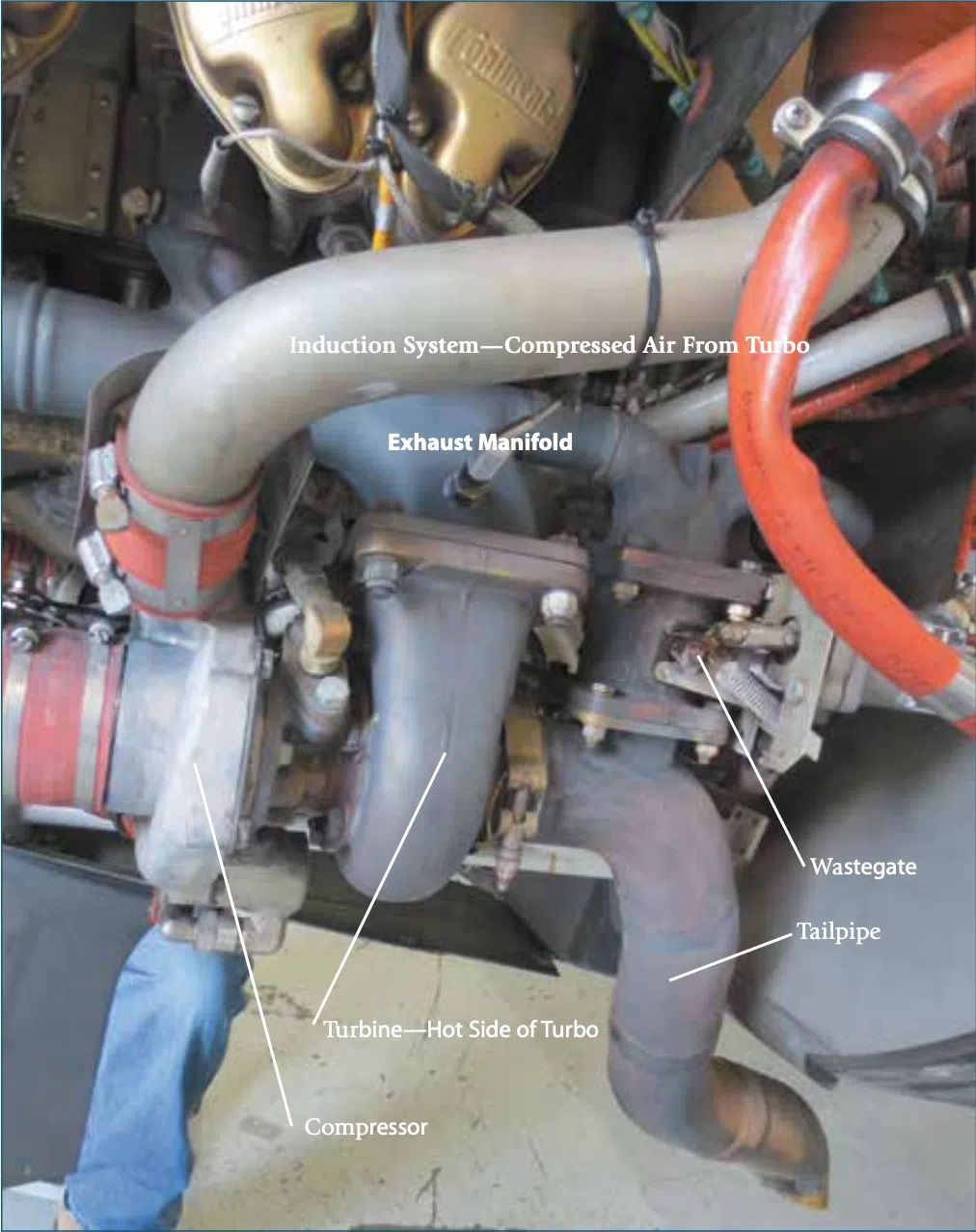
A wastegate—the butterfly valve in the exhaust pipe upstream of the turbo—routes air either down the remainder of the tailpipe or diverts it into the turbo, or some mixture of the two. When closed, it all goes into the turbo. 

Some wastegates are fixed—the pilot controls power with the throttle—and some are manual—there is a second control in addition to the throttle that the pilot must use in setting power. However, most are automatic—a controller senses the pressure of the air in the upper deck of the induction system, just upstream of the throttle body, and uses engine oil pressure to set the position of the valve in the waste-gate to maintain the manifold pressure the pilot has commanded with the throttle. Properly adjusted, an automatic system requires no action by the pilot during a climb or descent—which is not the case with a fixed or a manual wastegate.

When you discover that your system can’t make the promised manifold pressure at altitude, it doesn’t mean it’s time for an overhaul. According to Scott Utz, director of maintenance at Arapahoe Aero on Denver’s Centennial Airport, turbos hold up quite well—most of the time the problem will be something other than the turbo. See the sidebar “Care And Feeding And Figuring Out What’s Wrong” below.

Preventive Maintenance

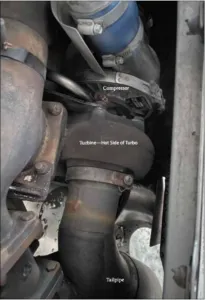
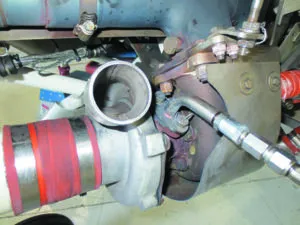
The induction system has been disconnected from the compressor side of this turbo for visual inspection. The oil supply routes into the center between the compressor and turbine. On this installation, a heat shield surrounds the turbine.

Utz pointed out that routine, preventive maintenance that keeps the engine happy is good for the turbo system as well. Keeping the air filter clean is good in general—on a turbo something as basic as a dirty filter means less air into the compressor, resulting in lower manifold pressure at altitude. 

Even with the impressive metallurgy and high-temp alloys used in their manufacture, the environment in which wastegates live mean that they sometimes fail. 

Otherwise, turbos do wear out and lubrication lines get plugged with coked oil—the result of the heat and speed at which the wheels are turning. That usually means it’s overhaul time.

Expected Life

We heard from owners and shops and spoke with Gary Main, proprietor of Main Turbo (www.mainturbo.com), a turbocharger overhaul shop, regarding expected life of turbos in service. From owners and shops we got a 50-50 split. Half said their turbos made it to TBO before needing overhaul, the others said they usually made it about halfway. 

Gary Main told us he was not surprised by the split. He said that the big turbos in the T210 and big twins are “strong and robust” and regularly make it to TBO. Where big power is demanded from the smaller ones, such as in a Cirrus, Piper Malibu or Aerostar, they don’t hold up as well. If the airplane is used for training or large, fast power changes are the rule, the turbo is more likely to expire prior to TBO.

Depending on the model of the turbocharger, overhaul costs start at $2500 for a T210 and go up—figure on at least $3700 for each one on a twin Cessna. It gets very ugly for the Aerostar as $4500 is the starting point and there are two per engine.  

Nevertheless, historically the cost of operating a turbocharged airplane has run only about 15 percent more than its normally aspirated cousin—inexpensive, in our opinion, for the added capability. We saw nothing to change that number.

Proper Operation

The bad news is that there are a couple of misconceptions about turbo system operations among pilots, and they may be reducing turbocharger life. 

First, a lot of pilots assume that the turbo is not spinning during low-power operation, such as on landing or during taxi. That is absolutely incorrect—there is always some exhaust gas going to the turbo, so it’s turning. 

Second, a surprising number of pilots did not know their airplane had limits on allowable manifold pressure above a certain altitude. Most know about critical altitude—the highest altitude at which the turbo will allow the engine to produce rated manifold pressure. However, at some point above critical altitude, the pilot must comply with a table that shows the maximum allowable manifold pressure and reduce power accordingly. 

For example, a Cessna 414A has published maximum manifold pressures for all altitudes above 20,000 feet. That’s because the turbine blades are spinning so fast and get so hot that they stretch—it’s called blade creep—and, if the maximum manifold pressure for the altitude is exceeded, there’s a high risk they will rub against the housing, causing rapid erosion. Ignore it and get welcomed to an early overhaul.

Overshoot

To get an idea of the harsh environment and tight quarters in which many turbochargers live, this is looking straight down on the turbo and tailpipe on the right side of the front engine of a Cessna P337 Pressurized Skymaster. The airplane is used in a Part 135 operation and the company president reports that he’s never had to overhaul a turbo prior to engine overhaul.

Because oil pressure controls the wastegate on an automatic system, it’s not unusual for the manifold pressure to overshoot—exceed redline—on the first takeoff of the day if the oil is still cold. The system is just sluggish. There is a popoff valve that should open to stop the manifold pressure from exceeding more than a few inches above redline and damaging the engine. It’s not a good idea to rely on the popoff valve—monitor manifold pressure on takeoff and stop it at redline. 

With a fixed or manual wastegate, the pilot has to set power—and because it takes a few moments for the turbo to spin up from its relatively low RPM during taxi and runup, the manifold pressure will lag behind throttle movement. Experienced pilots learn to stop throttle movement at some point below the target manifold pressure. Overshoot increases with takeoff elevation—we’ve seen it exceed 15 inches of manifold pressure on a takeoff from Leadville, Colorado, in a Turbo Arrow. 

Cruise

In cruise, back off a bit from a power setting that generates maximum Turbine Inlet Temperature (TIT). Turbo overhaulers and mechanics told us to back off at least 20 degrees to extend the life of the system, be it lean or rich of peak. 

Make all power changes gradually. After landing give the turbo time to spool down.  

At shutdown, the oil flow to the turbo ends and a hot turbo will coke the oil in the unit. That can eventually plug oil galleys and cause turbo failure.  

Many POHs call for a five-minute idle spooldown time after reaching parking. However, research performed on a Cessna Skymaster and more recently by GAMI produced the not surprising information that the turbo is the coolest it is going to get just after touchdown—unless there’s been a high-power approach and chopped throttle. 

The turbo heats up during taxi in. The conclusions were that unless you approach at high power, chop the throttle and taxi a short distance—by the time you reach parking, the turbo has spooled down to an RPM suitable for shutdown. 

Conclusion

After nearly 60 years in regular use in general aviation airplanes, we believe turbochargers have proven their worth and reliability for pilots who want to use their airplanes for more than just recreation.  

They don’t require any extraordinary care beyond what you would do to properly operate the engine. However, when there is a problem, failing to carefully troubleshoot it can send costs skyrocketing if a mechanic just starts replacing parts. 


Care And Feeding And Figuring Out What’s Wrong

In researching this article we got feedback from owners of turbocharged airplanes who reported that they had to overhaul the turbos at about 1000 hours of operation and an equal number who said that their turbos ran fine all the way to when they overhauled the engine. We came away with the opinion that an owner who follows good engine operating procedures generally—no rapid power changes, allowing the engine oil to warm up prior to takeoff and changing the oil on a schedule that reflects hours of operation as well as calendar time—can reasonably expect the turbo to make it to engine TBO.

In speaking with various shops and with Mike Busch, whose Savvy Aviation provides maintenance management to several hundred general aviation aircraft owners, we learned that when there is a problem with a turbo system it’s important to carefully troubleshoot the matter rather than blindly replacing components in hopes of fixing things. In general, there are five things that can go wrong with a turbo system: problems with the turbocharger, controller or wastegate, or leaks in the induction or exhaust systems. Most manifest initially with a loss of manifold pressure at altitude or premature bootstrapping (loss of manifold pressure control because the wastegate is closed). The underlying problems tend to have subtly different symptoms, so it’s important to carefully analyze what’s going on.

While there may be an underlying problem with the engine itself, such as a cylinder or ignition issue, most of those can be diagnosed with a good engine monitor—and we wouldn’t own a turbocharged airplane without a good engine monitor installed.

When you notice a problem, document the details as precisely as you can—power setting, manifold pressure behavior, airspeed, altitude and outside air temperature at the least.

If the problem is a sudden, dramatic loss of manifold pressure, assume worst case—that it’s due to an exhaust system leak, that hot exhaust gases are now spraying around inside the cowling and there is a very real and serious fire risk. Assuming anything else puts you and your passengers in danger. Reduce power immediately and land as soon as practical. If you’re flying a twin and can do so, shut down and secure the engine. Fires due to exhaust system failures have killed too many people. They are why there are a number of ADs calling for regular, careful inspection and maintenance of the exhaust systems of turbocharged engines.

We’re serious about this—while the ADs and awareness among A&Ps about the need for careful exhaust system maintenance have reduced the number of fires dramatically, the risk has not gone away.

After the flight it’s time for consultation with your A&P. If the cause was not an exhaust system failure, do a critical altitude check. That involves seeing if the engine will develop the manifold pressures at altitudes called out in the Airplane Service Manual. If it doesn’t make power and starts bootstrapping at a lower than expected altitude, the problem is most likely an induction system leak.

Induction system leaks may also manifest by higher than normal manifold pressure when idling on the ground. A leak may be spotted during a visual inspection or it may be necessary to pressurize the system with shop air, spray it with soapy water and look for bubbles.

Assuming that the exhaust system has truly been inspected every 50 hours, a leak is less likely than an induction system leak. Exhaust leaks are also easier to find on visual inspection as they leave stains.

Wastegates can get sticky due to lead, carbon, sulfur or coked oil accumulations. If manifold pressure seems to vary randomly, the wastegate may be going. Removing it and applying a source of adjustable air pressure can detect if it is closing smoothly as 50 PSI is approached. If not, it’s probably time for an overhaul.

We’re advised that controller problems are rare. On a twin, swap controllers and see if the problem moves. Otherwise, the poppet valve may have sludge that can be blown out with shop air in the oil return port. Make sure the upper deck reference line has no liquid in it. If it does, purge it and clean the controller’s aneroid chamber—that’s not as difficult as it sounds.

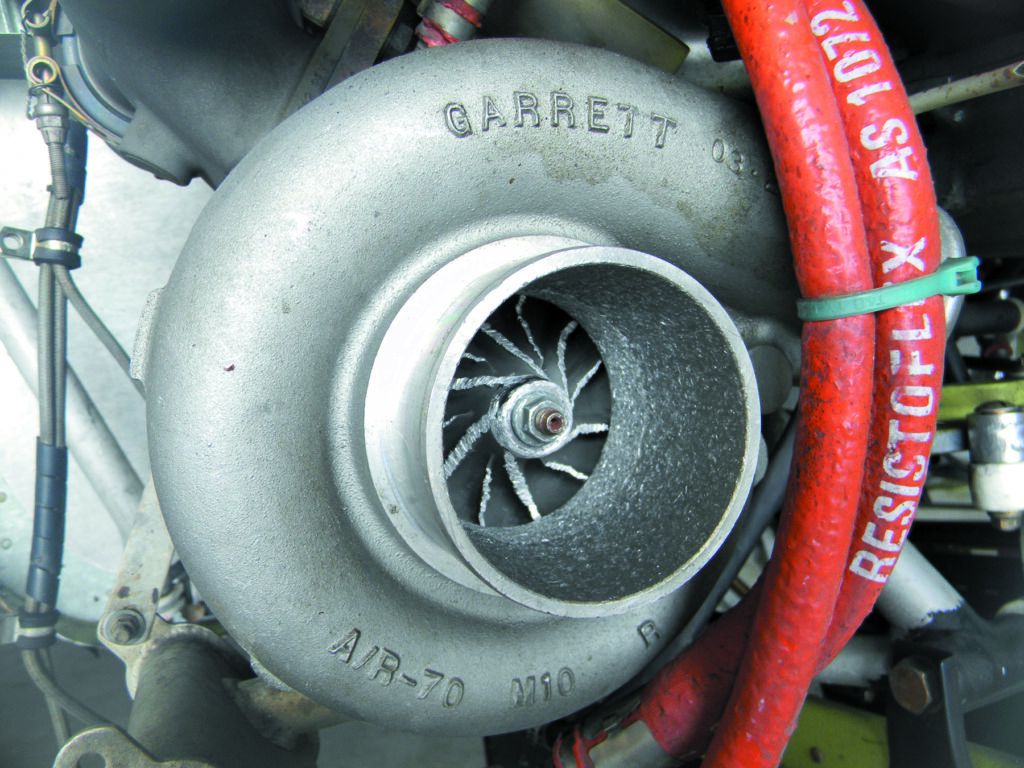
The turbo itself can go south—fortunately, that’s not high on the probability list. If that is the problem, it’s usually obvious. FOD, such as on the turbo pictured below, is easy to spot. Blades rubbing on the housing on the hot side can be observed when the exhaust pipe is pulled. A worn-out center section usually presents through oil leaking into the compressor and processing through the induction system and engine or into the turbine—resulting in oily deposits in the tailpipe and on the belly. However, oil in the turbo may be due to a bad check valve in the supply or return lines. Inspect them first as the turbo may be fine.


This article originally appeared in the May 2021 issue of Aviation Consumer magazine.

For more great content like this, subscribe to Aviation Consumer!